
Part of what makes college football so great is its unique combination of the enduring with the evolving. On one hand, there are standards like traditions, storied rivalries, and beloved venues that each generation shares with its predecessors. On the other hand, there is constant flux; coaches come and go, conferences realign, and every team’s roster looks completely different every 4-5 years. Over the past few years, the Army-Navy game has exemplified this dynamic of things changing, and things staying the same. It is one of college football’s oldest and most steadfast rivalries, but recent years have featured storylines highlighting that season’s changes. Army-Navy has been broadcast nationally for more than 50 years, including the last dozen on CBS, and will continue that way until at least 2018. It has, however, been moved from the first to the second Saturday in December. Change has been a theme on the field as well. The 2007 game brought us Stan Brock’s first year at Army, along with the speculation that it might be Paul Johnson’s last year at Navy. Last season was Ken Niumatalolo’s first as the Mids’ head coach, and he faced off against Army’s new option offense. The 2009 matchup will be the series’ third straight with a new head coach on the sidelines, as Rich Ellerson is wrapping up his first season at the helm of the Army football program.
Category: army-navy
THIS IS WHY WE HAVE A LINK TO THERE
Dan Steinberg at the Post’s DC Sports Bog is reporting that the Army-Navy Game will be played at Fedex Field in 2011. Initial reaction:

Now, I’m not privvy to the inner machinations of the bidding process, so I fully acknowledge that this could very well be the result of an offer that Army and Navy just couldn’t refuse. And if both sides want to continue getting competitive bids from other cities, it’s probably important to throw a bone to someone outside of New York, Philadelphia, and Baltimore once in a while. On the surface, though, it kind of stinks. Nobody likes Fedex Field; it’s a soulless, hard-to-access behemoth in the middle of nowhere that looks not unlike the ship that took ET back home. The Navy-Air Force games played there couldn’t get back to Annapolis fast enough.
My biggest concern, though, is the prospect of 20,000 empty seats at the game. Can Army-Navy really fill 90,000 seats? I hope so. Demand for tickets is probably enough to surpass the 65-70,000 that are available for games in Philadelphia and Baltimore, but 90,000 is a lot. People say that there’s a concentration of alumni and fans in the Washington area, so we’ll see. It didn’t make a difference for the Air Force game. Then again, nobody cares about Air Force.
UPDATE
NAVY 34, ARMY 0
Before the game on Saturday, John Feinstein told listeners on the Navy radio network that Army head coach Stan Brock’s job could depend on the outcome of that afternoon’s game. But unfortunately for Brock, it was over almost before it began.
Army fans and coaches believe that the talent level at West Point is about same as at Navy. At the very least, after hanging with Navy for a quarter or so in 2005 and keeping the Mids from pulling away in 2006, many people said that Army was at least “closing the gap.” Chip Bowden said that Army plays “lots of teams better than Navy.” Army AD Kevin Anderson must think that Army is talented enough, because he said in a press conference this week that he expects his new coach to win right away. But over the last few years of Navy’s unprecedented 7-game winning streak over Army, there are some plays that stand out as symbols for just how much Navy has separated itself talent-wise (or more specifically, speed-wise) relative to its fellow service academy. In 2005, there was Reggie Campbell turning on the jets and scoring on a 54-yard option pitch at the beginning of the second quarter. On the first play of the fourth quarter, Adam Ballard– a fullback–took a handoff from Lamar Owens on a trap play and outran Army’s defensive backs for a 67-yard touchdown. Last year, Zerbin Singleton took a toss from Kaipo and ran away from the Army defense much like Campbell did in ’05. Not to be outdone, Reggie returned a kickoff for a touchdown in the second quarter. Nobody on the field could catch Reggie… Except for Singleton, who was running beside him, escorting him to the end zone.
In Saturday’s 34-0 steamrolling of the Black Knights, it was more of the same. There was Shun White leaving everyone behind on Navy’s third play from scrimmage, streaking down the sideline for a touchdown. There was Army running back Wesley McMahand taking a pitch with literally nobody in front of him, only to have the Navy defense close in on him immediately. Army’s Patrick Mealy put together a great kickoff return… until he was caught from behind by Jordan Eddington. Think about that; Army’s kick returner being run down by one of Navy’s reserve linebackers. And when linebacker Ram Vela intercepted Chip Bowden’s pass with less than a minute left in the game, he pulled away from Army’s wide receivers as he streaked down the sideline. It’s amazing how a game traditionally renowned for being so evenly matched has become so one-sided. But there’s no arguing with the evidence. We like to focus on Xs & Os around here because coaching and effort are usually how Navy wins games. The Mids can’t just roll our helmets onto the field and expect to win, as PJ used to say. Don’t get me wrong, that’s still true with the Army game. But looking up and down Army’s starting lineup, it’s hard to imagine any more than one or two players that would crack Navy’s. The story of each game is becoming less and less about coaching and individual effort and more about sheer ability.
Not that coaching isn’t a factor too. Beyond the obvious reasons, I was interested in this game to see how Buddy Green would defend against an offense that is somewhat similar to Navy’s. Unfortunately for my curiosity, that isn’t really what I got. It was pretty evident that Coach Green didn’t have much respect for Army’s passing game or outside running– two things that defensive coordinators ignore at their own risk against the Mids. We’ll start with how Navy contained Army’s top (*cough*only*cough*) threat, fullback Collin Mooney. I mean other than just through sheer physical domination up front, since Nate, Matt, and Jabaree absolutely owned the line of scrimmage. Since so much of Army’s offense revolved around Mooney, Coach Green decided to sell out a bit to stop him. That selling out came in the form of safety Wyatt Middleton. Safeties are usually the last line of defense against option pitches, but Green sent Middleton charging to the line of scrimmage on most plays to spy on Mooney. If Wyatt saw that Mooney didn’t have the ball, he changed direction and went for the quarterback.
If someone tried this against Navy, they’d be burned like the tracks of a DeLorean with a flux capacitor. But Army couldn’t take advantage. To their credit, the Black Knights ran more option plays than I expected; certainly a lot more than they ran in other games. But on those few plays where Chip Bowden did read his way outside, Army’s running backs weren’t fast enough to outrun Navy’s defense. Army only got 10-12 yards on plays that Navy could have– and did– take all the way.
One other thing that the Navy defense did well was confuse the quarterback. I wrote about Army’s use of the mesh charge in last year’s game, with defensive linemen soft-playing the fullback before taking the quarterback. Last week, the Mids turned the tables:
I once asked a coach I respect how he would defend Navy’s offense. He told me that he’d focus less on scheme and more on confusing the quarterback. Give him several different reads to make, and if you find one he struggles with, run it at him until the offense adjusts. Buddy Green did a good job of doing just that. Stan Brock attempted that fake field goal because he knew that he couldn’t move the ball on Navy’s defense. He had to take advantage of the great field position given to him on the kickoff return because he didn’t know if he’d ever get that same opportunity the rest of the game. Sure enough, he never did.
Offensively, Ivin Jasper had prepared the Mids to face the same tactics that Army used last year. You’ll recall that the Black Knights pinched Navy’s tackles to prevent them from blocking the middle linebacker. To prevent that, he had his tackles release outside the defensive end:
Not the prettiest of plays, but the tackle forced the middle linebacker to alter his path enough for Shun to run by him.
The tackle released outside on Shun’s long touchdown run, too. But Army wasn’t trying to pinch the tackle on that play. The playside linebacker tried to play the pitch, but Shun ran through the arm tackle. Instead of running to cover the quarterback, the middle linebacker played the fullback. The tackle, who would usually block the middle linebacker, was then able to move on to the backside safety. That was the block that Shun needed, and off he ran to the end zone.
With that, it was “here we go again” for the Black Knights.
There were a couple of other interesting bits about Coach Jasper’s offense. Take a look at this picture:
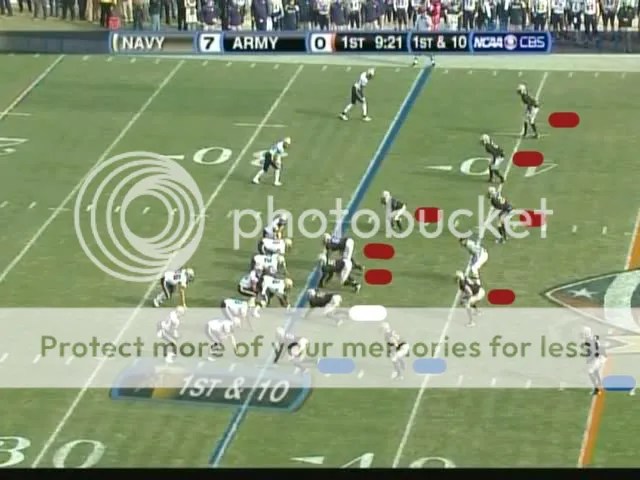
This play came early in the first quarter. A lot of times you’ll see the coaches throw in a few different formations early in the game to see how the defense will react. This is a good example of that. Coach Jasper brought twin wide receivers to one side of the formation. When he did that, Army countered by bringing seven (!) guys to that side of the field. One DT lined up over the center, leaving only three defenders to cover the other side of the formation. That’s a lot of ground for three people to cover, and Jasper took advantage of it. Later in the quarter he called a fullback option, with the backside guard pulling. The defensive end (the pulling guard’s assignment)actually takes himself out of the play by running to the middle of the field on his own. Kaipo options off of the playside linebacker, which leaves only the safety, who is blocked by the A-back. Poor Anthony Gaskins is left running around just looking for someone to block. The result is a long run by Eric Kettani down the sideline. After that, running away from the twin receivers became a theme for the offense, especially when lined up on the hash marks. It left a lot of field for Navy’s slotbacks– and not just Shun White– to outrun Army defenders to the corner and get downfield.
One curious play that caught me a little off guard was the draw play run by Shun White in the third quarter. I’ve watched a lot of this offense, from Paul Johnson’s two stints at Georgia Southern, to Hawaii, to Navy. I don’t recall ever seeing this play… That is, I’ve never seen it run by PJ. We have seen it, though. A lot.
Indeed, that draw play was a staple of Air Force’s offenses under Fisher DeBerry. I’m not sure if it’s new to the Navy playbook or if it’s always been a part of Paul Johnson’s offense, but Coach Jasper deserves credit for showing us a little something different either way. It’s plays like this that give us a glimpse at how the offense will evolve under him in Annapolis.
So there you have it: the straw that broke Stan Brock’s back. Chip Bowden might think that he plays lots of teams better than Navy, but nobody handed Army a bigger defeat this season. Army is left going back to the drawing board, while the Mids are off to yet another bowl game. The blowouts may be bad for TV ratings, but they’re good for the soul. After years of heartbreaking losses, I will never, ever take these wins for granted.
Postgame Haiku, Vol. 18
Back-to-back shutouts!
Commander-in-Chief’s Trophy!
Life is good, Navy.
RIGHT SAID FRED WOULD BE PROUD
What do you get when football and high fashion collide? The Army-Navy Game, naturally. Well, “high-fashion” might be a stretch. But as you have probably heard by now, Nike is using the Army-Navy Game to showcase the unveiling of its new “Enforcer” line of football uniforms. Both teams will come out sporting the new look, in uniforms apparently designed to honor the services they represent. Army will be wearing camouflage in one shape or another, while Navy will be wearing white jerseys with blue numbers, plus blue pants with a blood stripe (a la USMC) flanking either side. The stripe will be framed in gold. (You’ll have to take my word on this one).
I consider myself a traditionalist, as do many Navy fans. It’s kind of the nature of the school. And I can hear the wailing and gnashing of teeth now. DEATH BEFORE FOOTBALL UNIFORM ALTERATION! But hold on a second. Uniform stunts are a part of Army-Navy tradition, especially for Navy; from the throwbacks in 1999, to the blue helmets of 1993, to the orange helmets worn by receivers in 1962. Hell, Wayne Hardin like to do something different each year. There were the “Jolly Roger” skull & crossbones helmets, “BEAT” and “ARMY” written on the shoulders, and Chinese characters on the helmets to mess with Paul Dietzel’s “Chinese Bandits” defense, made famous when the Army coach was at LSU. And then there’s my personal favorite:

These things didn’t ruin the game or trample on the sanctity of the rivalry. Instead, they just became part of Army-Navy lore. Yeah, I know, it’s hard to get all misty-eyed for a Nike publicity stunt. But it’s fun for the players, and adds just a little zest to a game that has seen declining ratings. It isn’t the end of the world. I mean, we aren’t the ones wearing camouflage helmets (lol @ Army). Is that the opposite of the orange helmets? Will it look like a bunch of headless Cadets running around the football field?
So chill out! At least until we know that these things are absolutely heinous.
ARMY WEEK
Man, is it time for Army already? It doesn’t feel all that long ago that I was wondering what the heck I was going to write about Towson after spending all summer talking about the Alternative Service Option. Now here we are in December, rolling into the Game Of Games with a 7-4 record and making plans to head to RFK for yet another bowl game. Time flies when you’re having fun, I suppose. But if that’s the case, then August probably feels like a long, long time ago for West Point. After the emotional, controversy-filled offseason that saw the Alternative Service Option come and go, Army fans had to view the coming season as sweet relief. For once, there was cause for optimism on the banks of the Hudson. Yes, after a “defensive scrimmage” for a spring game that came after a double-secret spring practice that came after a double-secret “coaches’ retreat” meant to devise a new offensive scheme, word leaked that the option– the mighty, all-powerful, cure-for-what-ails-ya option– would be returning to Army.
Or so they thought, anyway. I’d like to tell a little story. Back in my midshipman glory days, some friends & I were sitting in the little slice of paradise known as deck 6-4 in Bancroft Hall and discussing high school football. One guy started telling us about his old coach. He told us about one game in particular, where his coach kept calling for the same play over and over again. After running it five times in a row, the coach called timeout. After gathering the team around him, the coach said, “OK, let get out there and run that play again. They’ll NEVER expect us to run in six times in a row!” That story more or less captures the essence of Army’s “option” offense. For the most part, the options end when the play is called in the huddle. When news broke on Tuesday that Army QB Chip Bowden suffered an ankle injury in practice, I wondered, “OH NO! NOW WHO WILL HAND THE BALL OFF TO COLLIN MOONEY???”
(Bowden, despite tweaking his ankle, is expected to start anyway.)

Indeed, the triple option at Army means offensive coordinator Tim Walsh deciding if he should call Mooney left, Mooney right, or Mooney up the middle. As predictable as the offense is, the fact that Mooney has been so productive this year is a real testament to his ability, and a credit to the line blocking for him. Before the season I mocked Army defensive coordinator John Mumford (deservedly so) for calling Mooney “probably better than any Navy fullback we’ve ever faced.” But to Mumford’s credit, Mooney has played one hell of a season. Another 54 yards, and he’ll have Army’s single-season rushing record. He’s 11th in the nation in rushing with over 1,200 yards despite everyone in the building knowing that he’s going to get the ball on almost every play.
This wasn’t Stan Brock’s design going into the season. Army started the year trying to run an actual option offense. It wasn’t Navy’s spread option; it actually resembled the wishbone derivatives run by Fisher DeBerry’s early Air Force teams. No matter what it was, it didn’t work. Quarterback play was a large part of the problem; not surprisingly, neither Bowden nor Carson Williams were very proficient in the offense after only one offseason running it. Bowden took over for Williams as the starter since, if neither guy is all that great running the offense, you might as well play the faster guy who might be able to break a long run here or there. But more than just the play of the quarterback, Army has had to make a pretty tough realization. It’s been a long-held belief by Army fans (and coaches too, judging by comments in recent years) that the Black Knights have pretty much the same talent level as Navy. The only thing they lacked, according to this theory, was the right scheme to fit that talent. Hence the preseason optimism; with Navy-like talent and a Navy-like scheme, maybe they would see Navy-like results. Unfortunately for those who drank the Kool-Aid, that hasn’t proven to be the case. Once Army started running an offense that looked a little like Navy’s, it was a lot easier to compare the talent between the two service academies. The results weren’t good for the Brave Ol’ Army Team. When it comes to overall team speed, they just don’t measure up.
The quarterbacks’ struggles take a lot of the option game off the table, and the lack of outside speed makes the perimeter rushing game less effective. So instead of trying to do something they couldn’t, Army’s coaches decided to focus on something they did well. That meant using strong offensive linemen and a bruising fullback to push the ball up the other team’s gut. It’s a role in which Mooney has flourished, and he almost single-handedly is responsible for Army’s 3 wins this season. That makes Nate Frazier the man of the hour for Navy’s defense. This is his Everest. Army is going to come right at him. Other than whatever tricks Stan Brock has up his sleeve, they can’t do much else. The last time this kind of a challenge was placed on Navy’s defensive line, Frazier, Nechak, and Tuani responded with a brilliant effort against Notre Dame. Hopefully they will do the same tomorrow.

For the Mids, there’s more uncertainty surrounding this Army-Navy game than there has been in years. The central issue for the Blue & Gold is who will start the game at quarterback. Ricky Dobbs started last week against Northern Illinois, and after some nervous mistakes on the first drive, he settled down to run the offense well enough to win. But according to Coach Niumat, Kaipo has been practicing all week and looking as good as he did back in the spring. But he hasn’t played in a month, and has only played one full game all year (Rutgers back in September). Do you go with the hot hand, or the seasoned veteran? Tony D’Amato went with Cap Rooney over Willie Beamen in the big playoff game, and that’s what I think Niumat will do–and should do– here. Most of you read Wagner’s blog too, and you probably are big fans of the weekly videos he puts out each Wednesday. In this week’s video, Wags feels that Navy should go with Dobbs. If this was any other game, I might entertain the thought. But don’t underestimate how big Army-Navy is. The last sophomore to start the Army-Navy game was none other than Kaipo himself in 2006. By his own admission, he was a nervous wreck and played a horrible game. This is the same guy who went into South Bend and actually waved his arms to get Notre Dame fans to make more noise, being so confident in his ability to pick up a first down. Kaipo is one cool customer, and even he struggled. And I’m sure nobody needs to be reminded of what happened in Charlie Weatherbie’s first Army-Navy game. Kaipo might be rusty, and who knows how healthy he is, but he’s the most experienced QB and most likely to keep his calm. I expect him to go as long his body can take it.
What he’ll be going against is a defense that has performed as well as any other against the Navy offense over the last few years. The first four Army-Navy games under Paul Johnson were characterized by the Navy offense running wild. In 2006, Kaipo had a rough game and the offense didn’t play as well. Last year Kaipo was fine, but despite the 38-3 score, all you heard on CBS was how well Army defended against the Mids. Navy fans were left wondering if Army found the magic formula to finally slow down Paul Johnson’s offense. Don’t worry, they haven’t. Army lined up with the same 4-3 look that Pitt and Notre Dame used this year.
Just like those two teams, Army focused on interfering with the playside tackle, freeing up their middle linebacker and allowing him to flow to the ball. I put two plays on this first clip here. On the first play, you can see the DE lined up outside the tackle and puching him away from the MLB, back towards the middle of the line. The defensive end can do this because the tackle is usually supposed to release inside of him on his way to the linebacker. One of the adjustments you’ll see the coaches make is to have the tackle release outside instead. It makes for a tougher read for the quarterback, but it keeps the tackle from getting caught in the pile. Just in case any of you think I’m full of crap when I tell you that defenses actively try to interfere with the tackle, watch the second play. Josh Meek releases outside of Army’s DE, but actually gets grabbed and pulled from behind to keep him from blocking the MLB.
Now, there are other adjustments you can make. What Coach Johnson did was run the double option, making the fullback a blocker and assigning him to the middle linebacker.
That wasn’t the only thing that Army was doing, though. The defense also did a good job of mixing in different reads to try to confuse Kaipo. Usually the defensive end was giving Kaipo a “keep” read when he turned to push the tackle towards the middle of the line. But sometimes, the DE faked going after the tackle, using his arms to push him instead of driving into him, then stepping upfield and into the quarterback’s path. It’s sort of like a pitcher with a good pickoff move to first base. This is called a mesh charge. The quarterback reads keep, but gets blown up in the backfield. It’s generally considered the toughest read for a QB to make in this offense, and it gave Kaipo fits at times:
When you get in the habit of reacting to one particular read, it can throw you off when the DE fakes that one read and does something else. Fortunately, Kaipo is quick to adjust and caught on to what Army was doing. The correct read on a mesh charge is to give to the fullback, and Kaipo made that read as the game wore on:
One other adjustment that PJ made to the mesh charge is similar to what we saw against Northern Illinois. Instead of optioning off of the DE, PJ put the tackle on him and called a designed handoff to the fullback. When the DE stepped upfield, he took himself out of the play. A great block by Reggie Campbell on the middle linebacker, and you have a nice gain:
These were good adjustments by Coach Johnson to keep the chains moving, but none of them were really designed to hit the home run. Go back through the video again and look at how aggressive Army was playing. The middle linebacker didn’t just flow to the ball, he really overpursued. Army’s secondary virtually disregarded the possibility of the pass, except in 3rd & long situations. These are usually the times when PJ unleashes the HAMMER OF THOR and calls play-action or a reverse that goes for 6. But he didn’t here. With huge defensive plays keeping Army out of the end zone, and huge special teams plays putting Navy into the end zone, he didn’t have to. Coach Johnson isn’t the kind of guy to tip his hand, especially with a team he’s going to face every year. If he can beat a team just by running simple stuff and winning field position, he will. That way, opposing coaches think their defensive scheme worked, and will try it again the next year. And that’s when you can unleash the mental Manhattan Project on them and blow them away.
Of course, none of this matters without execution, and that’s what Saturday’s game is going to come down to. Even if the strategy wasn’t the best, Army didn’t make it worse with bad execution. They played well, while at times the Mids did not. That said, it was a friggin’ five-touchdown victory. If Navy executes like they’re capable of, you’ll see more of the same. If we see more mistakes and inconsistency like in the Notre Dame game, it’ll be a lot closer. Rise to the challenge, and we’ll sing last.
Beat Army.
ARMY-NAVY GAME: ON THE MOVE
The Army-Navy Game has been on national broadcast television every year for more than hallf a century. That status won’t change for at least another decade, as it was announced today that CBS has extended its contract to televise the game through 2018. That’s not the only newsworthy bit from the announcement, though; as part of the deal, the game will move from the first weekend in December to the second, beginning next year.
I have mixed feelings about the move. This pushes Army-Navy right up against final exams, which sucks eggs through cocktail straws. It also makes bowl games a little complicated. Both the Poinsettia and Eaglebank Bowls are among the first, if not THE first, games of the bowl season. With Navy looking to be a regular in these games, that would mean they could have as little as seven or eight days to play Army, practice, and fly out to San Diego. It will make preparation difficult, especially when the other team wil likely have the full slate of available practices to prepare.
But the reality is that this move is probably necessary. The Army-Navy game and its television contract are the #1 source of revenue for both the West Point and Naval Academy athletic departments. With the advent of conference championship games being played on the same weekend, Army-Navy’s ratings have declined, making it less valuable to broadcasters. The best way to retain the value of the contract and restore the ratings to their former high levels– other than making both teams national championship contenders– would be to make Army-Navy the only game in town again. Otherwise, it wouldn’t make business sense for CBS or other suitors for the game’s broadcast rights to spend the kind of money that USNA and West Point need.
So the move makes sense, but there are still issues to address. Exams and bowl games, of course, but there’s also the issue of what to do with the extra weekend in the schedule. It’s hard to imagine that the team would go three weeks between Army and the previous game on the schedule. Will other games be scheduled for the first weekend of December, leaving only one week to prepare for Army instead of the usual two? Or will Navy start playing games on Thanksgiving weekend now? And does the new contract include Army-Navy basketball like the old one? Inquiring minds want to know.
VICTORY OVER THE BLUE SCREEN
I’m probably the most technologically backwards blogger on the internets. I built myself a computer four or five years ago, and at the time it was a mack daddy machine. It’d still be a competent appliance today if only it had lasted that long; a little more than a year ago it decided that it had better things to do than to carry out my bidding and just quit working. Since then I’ve been using my work laptop, in all of its Windows 2000 glory. An abacus would’ve been as effective a computer at this point. Now that I mention it, that’s actually true. On Wednesday, my trusty corporate relic bit the big one and gave me the dreaded blue screen of death, making it a big, gray paperweight. The “fatal system error” message contained in that doomsday screen hinted at the disaster churning inside, as the hard drive had gone and charbroiled itself into oblivion. So while Army-Navy news was buzzing all week, I was silent. But not anymore! Last weekend I ordered my Apple-powered electronic savior, and it arrived yesterday morning. So while I may be broke as hell now, at least I’m connected. Lucky you!
So what about that Army-Navy news, anyway? We’ll start with lacrosse.
Army-Navy lacrosse is moving to Baltimore next year. The Birddog Says: Meh.
Inside Lacrosse magazine, who brought you this year’s “Face Off Classic,” is at it again. Their new event is the “Day of Rivals,” and it’s a doubleheader featuring Army-Navy and Maryland-Hopkins at M&T Bank Stadium in Baltimore. There are two ways of looking at this. If you’re just a lacrosse fan, unaffiliated with either team… It’s great! The two games were played on the same day last year, and several area lacrosse fans made the trip for both. Putting both games in one place just makes things easier for people who’d otherwise consider making the trip.
If you’re a Navy fan… well, let’s just hope this doesn’t become a trend. Navy-Marine Corps Memorial Stadium is already about as great a venue as there is in lacrosse. Playing the game in front of 45,000 empty seats might seem like the “big time” to some people, but not to me. Not that I mind throwing a bone to the local lacrosse fan once in a while, but does it have to be the Army game? Anyway, while it isn’t something I’m looking forward to, it isn’t the end of the world, either. Maybe there’s a little bit of money to be made on the deal. If anyone’s pissed about this, it’s Army fans– this is a two-year deal, meaning an Army home game is being played in Baltimore. Sucks to be them.
Army-Navy coming to a city near you? The Birddog says: I’ll believe it when I see it.
Bidding for the privilege of hosting the Army-Navy game was last done in 2003. Back then, 15 cities across the country threw their hats in the ring only to see Philadelphia walk away with the prize as usual. It’s that time once again for groups to submit their proposals, and the buzz is already starting about the possibilities. Army-Navy in Dallas? Tampa? San Antonio? Chicago? Yeah, sure. Back in 2003, if you’ll recall, one of the strongest bids was actually submitted by Seattle. A lot of good it did them. It’s tough for a city outside the eastern seaboard to make a competitive bid since the host is responsible for paying travel costs for 4,000 midshipmen and 4,000 cadets. Yet even though Seattle supposedly found a way to make it work, it didn’t do them any good. Putting the game out of reach for tens of thousands of season ticket holders is something that each institution’s respective AD is naturally hesitant to do. So while I expect a lot of noise to be made about how many cities are submitting bids and how competitive the process is, I doubt that it’ll be anything more than a strong hint to Philadelphia to make sure their bid is up to par and their stadium isn’t in such disrepair that railings are held up with duct tape. Expect to be grabbing steaks at Pat’s after the Army-Navy game for years to come, with the occasional bone tossed to Baltimore.
(When the time comes for bidding to be opened for the 2026 game, I hope it goes to Chicago for the 100th anniversary of the original “game of the century.” God help me if I’m still blogging by then. Although I’ll probably be using the same computer…)
The other change that is on the horizon for Army-Navy is the possibility of a presenting sponsor. I’m all for it. Now don’t get me wrong, I don’t want to see “The Poulan-Weed Eater Army-Navy Game” any more than you do. But if it’s “The Army-Navy Game, presented by Northrop Grumman,” would that be such a disaster? Maybe if you work for Lockheed, but other than that it would just mean more money to pay coaches, recruit nationwide, and upgrade facilities. That = good. So if corporate sponsorship is indeed headed our way, here’s hoping it’s done the right way.
Army Postgame
| Boxscore | StatSheet.com |
Army’s defensive plan was simple: stop Greg Sprink at all costs. Whenever Navy’s best player touched the ball, he was met with a double-team. Navy probably would have done a lot better if they employed a similar strategy with Jarell Brown. Brown, Army’s only real scoring threat, scored 35 points, including the game-winning basket, to lead Army to a 69-67 win over the Mids at Alumni Hall. The loss dropped Navy to 2-3 in the Patriot League and kept them from pulling within a game of conference leader Lafayette, who lost to Lehigh on Saturday night. The Leopards are now tied with Bucknell for the top spot in the league.
Army started the game with an 11-0 run as Navy came out and looked lost. Once the Mids settled down, though, they started to play some good basketball. If there is anything positive to take from this game, it’s that other players stepped up when Army went after Sprink. In the first half, Adam Teague’s 3-pointers and steals helped the Mids to dig out of their early deficit and actually take a lead into the half. In the second half, Mark Veazey came out on fire, scoring points underneath the basket, blocking shots, and making some tough rebounds. Chris Harris added 20 points and 5 assists, although he was only 5-18 from the field. And despite Army’s efforts, Sprink actually had a decent game statistically, scoring 20 himself while pulling down 6 rebounds. While Army’s defense couldn’t stop Greg Sprink from scoring, they did force him into 7 turnovers. Greg tried to fight through double-teams to force fouls and get to the free throw line, but too often he came in out of control and gave up the ball. Army’s defense, though, wasn’t the cause of his biggest gaffe of the night. Sprink took a pass after a steal at half-court and missed what appeared to be some kind of hot-dogging, rim-rocking, wide-open dunk attempt. Navy actually got the offensive rebound, but the Black Knights got a steal and wound up with a 3-point play on the other end. The resulting 5-point swing may have been the difference in the game.
I can sympathize with Greg Sprink. I can imagine what he was thinking. This was Navy’s biggest rival in an important Patriot League game, but you’d never have known that by listening to the crowd– especially the Brigade. They were dead. But if Greg could pull off that dunk, maybe he could have shot some excitement into the Mids. Maybe he could have brought the crowd into the game. And a play like that can be demoralizing for the other team; maybe it would have broken Army’s back. At the very least, maybe whipping the crowd into a frenzy would have forced Jim Crews to call a timeout or something. Unfortunately, none of those “maybes” were more important than the actual 2 points.
Even with that 5-point swing, it was still a tie game inside of a minute to play. Army had the ball, and everyone in the building– well, those who were paying attention to the game, anyway– knew who was going to get the ball. Why, then, did Billy Lange put Greg Sprink, with his four fouls, on Jarell Brown? Greg couldn’t contest Brown’s shot because if he fouled out, Navy would be without their best player in a potential game-winning or tying situation. And as Brown drove down the right side, nobody slid off of their man to help out. Brown’s game-winning shot was a way-too-easy layup.
Navy has had significant second-half leads in each of its three Patriot League losses. With Billy Lange’s 3-point-happy offense, Navy can race out ahead of anyone. Unfortunately, it also means that anyone can come back to beat Navy as soon as the shots stop falling. Playing up-tempo and shooting 3s might not be the best way to handle situations where you want to limit the other team’s posessions. I’m on board with the basics of Lange’s offense. I wasn’t at the beginning of the year, but Chris Harris has stepped up as a scoring threat to take pressure off of Greg Sprink. Now Lange has to draw something up to help his team hold on to the leads they build.
|
Shooting
|
Rebounds
|
|||||||||||||||
|---|---|---|---|---|---|---|---|---|---|---|---|---|---|---|---|---|
| K. Kina (G) | 22 | 1 | 0-6 | 0 | 1-2 | 50 | 0-4 | 0 | 1 | 1 | 2 | 1 | 0 | 0 | 6 | 4 |
| C. Harris (G) | 40 | 20 | 5-18 | 27.8 | 5-6 | 83.3 | 5-14 | 35.7 | 2 | 2 | 4 | 5 | 2 | 0 | 2 | 1 |
| G. Sprink (G) | 38 | 20 | 6-18 | 33.3 | 6-7 | 85.7 | 2-8 | 25 | 2 | 4 | 6 | 3 | 2 | 0 | 7 | 4 |
| R. Garcia (G) | 25 | 3 | 1-3 | 33.3 | 0-0 | 0 | 1-2 | 50 | 0 | 6 | 6 | 0 | 0 | 0 | 2 | 1 |
| M. Veazey (C) | 21 | 9 | 4-7 | 57.1 | 1-3 | 33.3 | 0-0 | 0 | 4 | 3 | 7 | 2 | 0 | 3 | 1 | 2 |
| A. Teague | 28 | 13 | 5-7 | 71.4 | 0-0 | 0 | 3-5 | 60 | 2 | 4 | 6 | 1 | 4 | 2 | 0 | 2 |
| B. Richards | 19 | 1 | 0-2 | 0 | 1-2 | 50 | 0-0 | 0 | 5 | 1 | 6 | 2 | 0 | 0 | 0 | 1 |
| C. Colbert | 7 | 0 | 0-0 | 0 | 0-2 | 0 | 0-0 | 0 | 0 | 0 | 0 | 1 | 1 | 0 | 0 | 1 |
The Future of Army-Navy

With Navy’s 6th straight win in the series, we’ve reached a new frontier in Army-Navy history. Until now, neither team had ever been able to string together this many consecutive victories. It isn’t the first big streak, though. Army won 5 straight from 1992-1996, and that was part of a longer trend as the Cadets (not the Black Knights back then) were 9-2 against Navy from ’86-’96. That followed a stretch from 1973-1985 where Navy had the upper hand, going 10-2-1 against Army. The Mids had two other 5-game win streaks; from 1959-1963, and from 1939-1943. Army didn’t lose a game to Navy from 1922-1933, although there were two ties over that span (including the 1926 “Game of the Century”). So while a winning streak this long is unprecedented, streaks in general aren’t unusual in the rivalry.
Unlike most of these other streaks, though, the wave that Navy is currently riding comes at a time where TV money dominates college football. Army and Navy are not immune to the need for cash to remain competitive, and one of their biggest sources of revenue is the Army-Navy Game. Does Navy’s winning streak make the Army-Navy Game less desirable to broadcasters? One could argue that Army’s winning streak from ’92-’96 came in the same TV money era, but those were all close, exciting, competitive games (Army won by an average of 2 points per game over that span). The average score during Navy’s current run is 40-12. Will the lopsided results of the last 6 years have an adverse financial impact on the Navy football program?
CBS outbid ABC for the rights to broadcast Army-Navy at the end of Army’s 5-year run, and that 10-year contract expires after next year. They bent over backwards to win back then, too. I mean, really, is there any other reason why you’d see Army-Navy basketball on CBS each year? It’s part of the Army-Navy football package. CBS made the bid for a good reason; back when they won it, Army-Navy was the only game in town. At least the only college football game, anyway. This was before conference championship games; Army-Navy’s main TV competition was college basketball. Since football is king in this country, it wasn’t much competition at all. From the Atlanta Journal-Constitution in 1989:
The Army-Navy football game has no implications on the national championship, but it’s the one game CBS can count on every year for a solid rating, even when the competition is a pair of basketball games including ranked teams. Judging by the overnight Nielsen ratings, Army-Navy blew away the basketball with a 7.7 national rating (9.8 locally) to 3.3 for ABC’s doubleheader between Duke-Michigan and North Carolina-Iowa and 2.7 for Oklahoma-Nevada Las Vegas on NBC.
Compare that to this year’s ratings, courtesy of Sports Media Watch:
College football ratings
8.3: BCS Selection Show (Sun., 12/2, 7:45 PM FOX); down 12% from ’06.
7.3: Big 12 Championship Game, OK/Miss (Sat., 12/1, 8 PM ABC); up 74% from ’06.
6.0: SEC Championship Game, LSU/TN (Sat., 12/1, 4 PM CBS); up 28% from ’06.
4.2: ACC Championship Game, VT/BC (Sat., 12/1, 1 PM ABC); up 5% from ’06.
3.8: USC/UCLA (Sat., 12/1, 4:30 PM ABC); down 54% from ’06.
2.4: Army/Navy (Sat., 12/1, 12 PM CBS); down 8% from ’06.
I can’t find a link, unfortunately, but I read last year that the ratings for the 2006 edition of Army-Navy were down 20% from 2005. The 2005 game was a big one, if you’ll remember. Army came in on a 4-game winning streak, including a win over Air Force. Navy was 6-4. Army played what many claimed was a tougher schedule, and there was a lot of talk about how Army had “caught up” to Navy and that the Black Knights were going to put up a better fight. There was a decent amout of hype surrounding that game. But the people who tuned in ended up seeing another Navy blowout. When 2006 rolled around, viewers apparently weren’t going to be fooled again. And that might be a problem when we take bids on the game next year.
There is a certain core group that will watch Army-Navy no matter what. People like the pomp & circumstance that surrounds the game. A lot of these types might not watch another college football game. But that group isn’t very big. College football fans appreciate a good rivalry, because they know that there will be drama when the game is close. It makes the game appealing even if both teams come into the game with losing records. But when the game isn’t close, those fans tune out. And lately, fans have been tuning out the  Army-Navy Game. Fewer viewers mean less ad revenue. Maybe I’m imagining things, but I really felt like there were fewer commercials during the game this year. And half of those commercials came from one company (Jeep). If advertisers aren’t buying time during the game, then the game is worth less to broadcasters. If the game is worth less, then bids won’t be as high. And that goes straight to NAAA’s bottom line. (By the way, the Subway ad with the ref explaining a blown call and how he was going to do a “make-up call” in the second half was hilarious.)
Navy’s success is paying dividends in season ticket sales, bowl games, and CSTV. But if we don’t want Army-Navy to dry up, then Army needs to get better soon.
Future sites: The other big part of the future of the game is where it will be played. After its second trip to Baltimore in 7 years, the game returns to Philadelphia in 2008 and 2009. Cities will soon start bidding for the next round of games beginning with 2010. Last time around, 16 cities from Miami to Boston to Seattle to San Antonio explored the possibility of hosting Army-Navy. The cost of transporting 8,000 midshipmen and cadets, though, limited the number of candidates with a relistic shot at winning. Nevertheless, I expect roughly the same number of cities to at least explore the possibility of bringing Army-Navy to town.
I believe that the game belongs in Philadelphia. I think that being associated with a single city adds to the name-brand recognition of the game, like a bowl game. Being located halfway between Annapolis and West Point makes obvious sense for season ticket holders at both schools for whom the Army-Navy game is the crown jewel of their ticket packages. The only thing that would change my mind is if Philadelphia started taking the game for granted again. Any more cardiologists’ conventions booking up all the hotel rooms or stadium railing held up by duct tape, and it’d be time to shop around. But the city really poured it on with their bid last time, and it certainly seems unlikely that they’d make the same kinds of mistakes again.
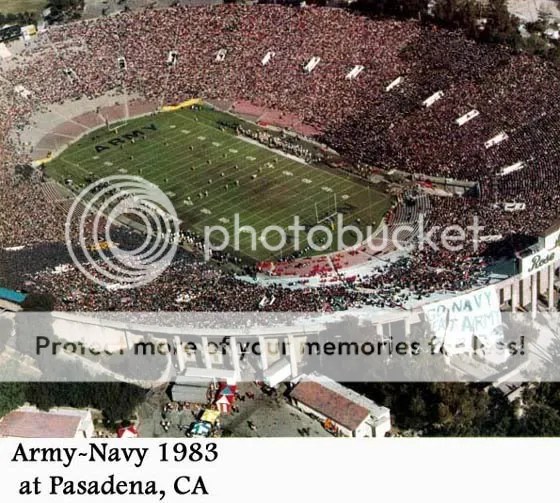
I know a lot of people want Army-Navy to be a sort of college football roadshow, moving to a different site around the country every few years or so. It is, after all, the “nation’s rivalry.” I can understand the sentiment, but I don’t agree with it. We talk a lot about the value of playing a “national schedule” so as to promote the Naval Academy in different parts of the country. But it isn’t really the games themselves that promote Navy; it’s the week of media coverage leading up to the game. When Navy goes to, say, Durham to play Duke, there might be 15-20,000 people actually at the game. But there are probably 100-200,000 people who will read the area’s newspapers. And when a visiting team comes to town, that means that the paper will be writing about them for a week. That’s where the value of playing a national schedule comes in. It’s so people in North Carolina and Texas and wherever can read about Zerbin Singleton, Antron Harper & co. Local media exposure helps to tell the Naval Academy story. But the Army-Navy game draws national media attention no matter where it’s played, so there’s little to be gained by moving it. The value of shipping the game around, in terms of exposure, certainly doesn’t outweigh the costs. And while both Army and Navy have fans and graduates all over the place, it’s a much simpler process for those folks to take a trip to the game than it is to move the game to them. The 1983 game at the Rose Bowl was allegedly a financial disaster.
Those of you who enjoyed the game in Baltimore, don’t hold your breath about seeing it there again anytime soon. Then again, a lot of attitudes can change in two years.
 The Birddog