The opening week of the college football season will always hold a special place in my heart. Aside from providing a usually welcomed and much-needed break from a whole three or four days of classes, it has always managed to indulge that innate sports fan desire in me to see an upset. David vs. Goliath matchups? Week One always provides plenty of them, and that’s not likely to stop anytime soon. Sure, fans of BCS conference teams may moan ad nauseum about playing the Little Sisters of the Poor (who, it turns out, don’t actually field a team), but with the state of television contracts and ticket sale revenue being what they are, the incentive to play an FCS team isn’t the opportunity cost loss some people would like us to think it is.
Good for people like me who enjoy watching the ACC take its annual nose dive or two against Colonial Athletic Conference teams, but good for the FCS teams playing? According to Delaware head coach KC Keeler, maybe not. That, at least, if you’re going off of what Keeler said in the weekly CAA teleconference on Monday:
My preference is to not play any I-A teams. The goal of our program is not to win a I-A game, it’s to win a national championship. It’s really difficult to make the playoffs and we need to put ourselves in the best position possible to do so. We need to have enough wins to get into the playoffs.
Interesting comments, no doubt, especially when you factor in the history of the Navy-UD series. As Bill Wagner points out in his blog, the series has been going back to 1984 and is currently sees Navy with an 8-7 series advantage. Hardly the kind of one-sided stomping that certain SEC or Big 10 schools unload on their FCS “rivals” on a yearly basis, and by and large good football to watch regardless of the week the game is being played in.
While I don’t presume to actually define what’s good and what’s not good for the Delaware program, I can’t help but question what is behind Keeler’s comments, and if they’re really meant to be taken at face value. True, his team is among dozens fighting for 10 at-large spots in the playoffs if they don’t win the CAA – but I’m sure Keeler would tell you that winning the CAA is the first goal of his program each year, if only because it would include a bye in the playoffs and a possible streamline to the National Title Game. Likewise, if we’re to believe recent history, then beating an FBS team – especially a perennial bowl team like Navy – carries quite a bit of weight with the NCAA committee when considering at-large bids. So wouldn’t it help Delaware to keep playing a game against an FBS team like Navy? My inclination says it would, especially now that one of the CAA’s best teams – Massachusetts – is heading up to the FBS.
Smoke and mirrors? I’m not saying it is, but something tells me to take these comments with the suspicion of coach speak. Keeler’s program is established enough that it’s always going to be in contention for an at-large spot in the playoffs even if his team doesn’t win the CAA, and given the demanding CAA slate and the incentives of upsetting Navy, it seems a productive use of a game to travel down to Annapolis. The real reason for the comments? Economic, perhaps, but also to deflect attention from the matchup, and to downplay media attention for the upset that he and his players are banking on.
He cares. His team cares. They just don’t want you to know how badly they do.
Forget joining a BCS conference. Instead, create a service academy all-star team. Cherry-pick the best players from all three. Put THAT team in a BCS conference. How would they do? I mean as a program year after year, and not just in 2011.
Thanks to my terrible work ethic, the M.O. for this blog over the last year or so has been for me to comment on things about a month after everyone stops caring (Man, the Casey Anthony verdict is making my Twitter timeline unreadable! And can you believe the U.S. women lost to Sweden?). But I can’t move on to other things without mentioning a few items of varying levels of interest, so let’s do that first.
LACROSSE: Obviously, item #1 on the docket is the hiring of Rick Sowell as the new lacrosse coach. Sowell comes to Navy by way of Stony Brook, where he went 47-26 over five seasons. The Seawolves won the America East regular season the last two seasons, and won the conference tournament in 2010. Stony Brook was a respectable America East program when Sowell took over, but the 2010 season was the best in the program’s short history, earning the #8 seed in the tournament and advancing to the quarterfinals before dropping a 10-9 decision to top-seeded Virginia. Stony Brook again advanced to the America East finals in 2011 before losing a heartbreaker to Hartford in the final seconds (or second, actually).
I like the hire. If Richie Meade had retired on his own terms instead of being forced to resign, I think most people would share my optimism. Unfortunately, the nature of Meade’s dismissal means that some people aren’t going to give any new coach a chance. That doesn’t mean that there aren’t some legitimate questions to be asked, though. Is Sowell the kind of coach that the old-timers had in mind as they spent the last 5 years calling for Meade’s dismissal? He certainly isn’t as accomplished as Meade. He could be when all is said and done, but were the ’60s laxers expecting more of a sure thing? We’ll find out the answer when we see how long it takes for them to start complaining again. And make no mistake, they will; the kind of success that they want isn’t sustainable at many schools, let alone a service academy. Keep in mind that these guys were complaining before the struggles of the last two seasons. I’ll be happy if Sowell matches Meade’s record at Navy.
Some might question whether or not he can, but the basis for some of the criticism of the hire is unfair, in my opinion. While his record at Stony Brook was better, Sowell’s overall record is just a hair over .500 at 86-81. Not all .500 records are the same, though. Sowell took on some thankless jobs. Before taking the helm at Stony Brook, Sowell started the St. John’s program from scratch. Before that, he took over a Dartmouth program that had two winning seasons in the 16 years that preceded him. By the time he left the Big Green, he had won the Ivy League and had notched the program’s first win at Princeton since 1956. Seriously, he won the Ivy League at Dartmouth. I don’t think that can be said enough. They’ve had a steady downhill trend ever since he left. So yes, he’s about .500, but with some of the challenges he took on, that’s an accomplishment.
Everyone knows what I thought about Coach Meade’s dismissal, but none of that matters anymore. The program marches on– the Mids themselves will march on– and I’m excited to see where Coach Sowell can take them. Welcome aboard.
#@$%ING CBS: John Feinstein’s 14 years in the Navy football radio booth have come to an end. After having pitched the idea of an Army-Navy documentary for a while now, he was understandably upset when CBS decided to move forward with a documentary of their own. He says that he isn’t throwing a fit, but to watch CBS working on this documentary in front of him all year would be too much to take.
It’s a little bit like dating a girl for 10 years, getting dumped and then being invited to her wedding. I just don’t want to watch it.
It certainly does sound like a hissy fit, but I’m more than willing to give Feinstein the benefit of the doubt. One, because everyone I’ve ever talked to that knows Feinstein has nothing but nice things to say about him; and two, because I have no idea how much of a slap in the face this is professionally and can’t possibly relate to any of it. I might be a little disappointed in his decision since NAAA stood by John after he dropped an F-bomb on the air, but only a little; it wasn’t that big of a deal.
In fact, I’m actually sort of glad to see him go. I’ve never liked him on the radio. His ability to tell a story makes him a great writer (and probably would have made him a good documentarian for that matter), but that doesn’t translate much to an in-the-booth game broadcast. Yes, he’s a national media voice in a time when there aren’t many others who give a rat’s ass about the Naval Academy. On the other hand, I disagree with just about everything that comes out of his mouth on the air. I don’t know if losing Feinstein will lead to decreased interest in Navy radio broadcasts, but I do know that I’ll do less in-game yelling at people who can’t hear me, so my blood pressure likes the news.
I’m sure Feinstein will be back when he realizes how much he misses the postgame Juicy Juice benders with Socci.
THE MOST IMPORTANT PART OF THAT STORY: Showtime is going to air a two-hour documentary on Army-Navy!
SPEAKING OF CBS:They’ll be showing the Air Force game. That’s CBS as in CBS, not the CBS Sports Network as usual. That’s a big deal, but the cherry on top is that the game is now going to be played at noon. TAILGATERS REJOICE. Seriously though, noon game on CBS? The decision to partner with CSTV instead of ESPN looks better every year. Unless the game is preempted by some garbage ACC game locally, in which case I will embark on a murderous rampage (just kidding) (or am I) (I am) (maybe).
OTHER PEOPLE’S PROBLEMS: Georgia Tech has become the latest program to be flattened by the NCAA regulatory bulldozer. OK, “flattened” might not be the best way to describe it, but the punishment includes probation, a $100K fine, and forfeiture of all 2009 wins after November 24 (including the ACC championship). The From The Rumble Seat reaction ranges from acceptance to WTF as details of the story became public. Those details can be found here.
If the punishment seems excessive, it is. Remember, though, that Georgia Tech was already on probation when all this was happening, so any violations that happen during the probationary period are going to deliver an extra dose of boomshakalaka. Still, I don’t know if forfeiting Tech’s ACC championship makes sense. The school plans to appeal, and while it will probably be denied like most appeals are in the new NCAA process, that doesn’t mean that they don’t have a point. The NCAA forces a forfeiture of wins when it finds that ineligible players were used in these contests. While they did find that one of the two investigated players received “preferential treatment” by being given $312 worth of clothes from his cousin’s roommate, the NCAA did not say that either player was ineligible in its report. If either player was in fact ineligible, the NCAA should have made that clear. If they did not determine that the players were ineligible, then Tech shouldn’t have to forfeit any wins. As for the rest of the penalties, meh.
I bring it up because Paul Johnson’s connection might be of some interest to Navy fans. His involvement in all of this is apparently that 1) he was told of the investigation when he shouldn’t have been, and 2) he then told the players in question. I know, rules are rules, but if I was in Johnson’s position I don’t think I would have done anything differently; coaches make their living in part by earning the trust of teenagers. Keeping something like this from them might feel like a betrayal of that trust, and I suspect that part of the reason why the NCAA doesn’t want coaches to know about investigations like this is for the coach’s sake. Still, if it is normal practice for schools to suspend players pending the result of inquiries into their eligibility, how can anyone not know what is happening? That sort of lets the cat out of the bag, doesn’t it? Someone explain it to me.
Anyway, for his part Coach Johnson has been pretty quiet on the subject LOL NO HE’S NOT.
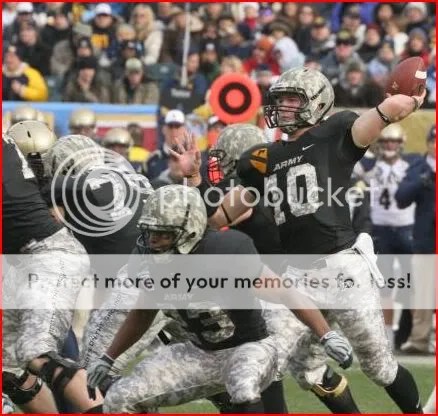
WHAT REALLY SHOULD BE AN NCAA VIOLATION: Army’s duck-hunter uniforms from 2008 were certainly a violation of something. The all-camo getup against VMI had a little more to offer in gimmicky appeal, but didn’t exactly raise the bar aesthetically. Hopefully Nike takes a different direction with the Pro Combat unis they’ll be giving Army and Navy this year.
WHERE DID ALL THESE FLOATING TORSOS COME FROM
IN OTHER SERVICE ACADEMY NEWS: Troy Calhoun’s solution for graduation rates? Bribery!
NIUMAT’S CONTRACT EXTENSION: It was really just a down payment for a plane ticket to Guam.
FEINSTEIN’S DREAM DEFERRED: John will have to wait another 15 years for the Navy-Notre Dame series to end. I don’t think he’ll mind playing Marshall, though.
My blog is sort of like the chicken pox virus: causes itchy bumps, then lays dormant for years before stress causes another painful breakout that can only be treated with herpes medication. I wouldn’t wish it on anyone. If you’re institutionalized and miss the pain, though, don’t forget that you can find me on Twitter even when this place is gathering dust.
I don’t care that much about the NFL draft, but I do like to see how many Navy opponents get selected. Here’s this year’s list:
Round 1
Aldon Smith – DE – Missouri
Blaine Gabbert – QB – Missouri
Jonathan Baldwin – WR – Pittsburgh
Muhammad Wilkerson – DT – Temple
Cam Heyward – DT – Ohio State
Round 2
Jabaal Sheard – DE – Pittsburgh
Kyle Rudolph – TE – Notre Dame
Jaiquawn Jarrett – DB – Temple
Torrey Smith – WR – Maryland
Round 3
Vincent Brown – WR – San Diego St.
Alex Green – RB – Hawaii
Round 4
Greg Salas – WR – Hawaii
Chimdi Chekwa – DB – Ohio St.
Round 5
Kealoha Pilares – WR – Hawaii Brandon Burton – DB – Utah*
Dion Lewis – RB – Pittsburgh
Jason Pinkston – OL – Pittsburgh
Jermale Hines – DB – Ohio St.
Round 6
Dwayne Harris – WR – East Carolina
Aldrick Robinson – WR – SMU
Caleb Schlauderaff – OL – Utah
Brian Rolle – LB – Ohio St.
Ross Homan – LB – Ohio St.
Round 7
Derek Newton – OL – Arkansas State
Da’Rel Scott – RB – Maryland
Greg Romeus – DL – Pittsburgh
Andrew Gachkar – OLB – Missouri
Demarco Sampson – WR – San Diego St.
Cheta Ozougwu – DL – Rice
We all have our problems, I guess. For Mr. Campbell’s sake, I hope his West Point degree is worth more in his employment search than an Air Force Academy degree is. It’ll take a while to pay back the government if your only prospects are plumbing and chicken wings.
In other news, there was a time when a headline like this would seem a little ridiculous when talking about a soon-to-be service academy graduate. I guess not anymore.
The EagleBank Bowl, briefly called the Congressional Bowl at first, has a new sponsor in Northrop Grumman. With a new sponsor comes a new name: The Military Bowl. A curious choice, considering that there is already an Armed Forces Bowl.
There’s so much going on in DC that there has to be a better name than “Military Bowl,” right?
Navy’s winning streak over Air Force started back in 2003. The upstart 2-2 Mids came out of Landover with a 28-25 win over a Falcons team that had come into the game 5-0, fresh off a win over conference nemesis BYU, and ranked in the top 25. With another convincing win over Army two months later, Navy had earned its first Commander in Chief’s Trophy in two decades. It had been so long that USNA officials had no interest in waiting for Air Force to ship it to them. The day after the game, deputy athletic director CAPT Greg Cooper was dispatched to Colorado Springs with orders to claim Navy’s prize. He flew to Colorado, rented a U-Haul, loaded it up, and after a few days driving toward the sunrise on I-70, brought the trophy to its new caretakers. One of my favorite images in Navy history came from Craig Candeto and Eddie Carthan bringing the fruit of the team’s hard work to the locker room for the first time:
The trophy has remained in Annapolis ever since. Keeping it there is the football program’s top priority, but not because of rivalries or bragging rights or any other chest-thumping hoopla. The reason is much more matter-of-fact: it is important because the other service academies are Navy’s primary competition in just about everything. These are the schools that are most like USNA. They are who the coaches recruit against. The competition between them is the only apples-to-apples gauge for how the program is doing. After holding on to the trophy for seven years, it’s safe to say that the Navy program is doing pretty well. The road to making it eight years begins Saturday when Navy goes to Colorado Springs to take on Air Force once again.
When I was at the Naval Academy, I had a friend who thought that George Welsh was overrated. He didn’t understand how a team could produce so much NFL talent, yet only manage to go 7-4 every year. I can only imagine what he’d think of Ralph Friedgen, who turns out a ton of NFL talent but has had 4 losing seasons in the last 6 years. That wasn’t always the case; the Maryland alum took over at his alma mater in 2001 and promptly led the Terrapins to three straight 10+ win seasons and an ACC title. Friedgen hasn’t been able to maintain that kind of success, though, and the prevailing theme of the Maryland offseason was the embattled coach’s job security. It didn’t help that former Maryland AD Debbie Yow made it known that she expected at least a 7-5 season out of the football team in 2010. Yow has since departed to take the AD job at North Carolina State, but that probably doens’t do much to comfort Friedgen. New athletic directors tend to have itchy trigger fingers; if they’re going to be held accountable for their football program’s success, they’re going to at least have their own hand-picked guy in charge. (Yesterday, it was announced that Maryland hired Army’s Kevin Anderson to replace Yow.)
It’s against this backdrop that Maryland heads into tomorrow’s game against Navy. Coming off of last year’s 2-10 debacle, the Terps are a 6-point underdog to the Mids, which belies the considerable talent that they have on their roster. At 6-3, 250, middle linebacker Alex Wujciak is a monster in the middle, piling up 131 tackles to earn a second all-conference selection. Standout middle linebackers have had some success against the Navy offense; Pitt’s Scott McKillop comes to mind. Fellow linebacker Adrien Moten also returns after leading the team in sacks and tackles for loss a year ago. Up front, nose tackle A.J. Francis was a freshman all-American in 2009. On offense, junior receiver Torrey Smith returns after an all-ACC season where he was 6th in the nation in all-purpose yards. Maryland also has considerable depth at running back, led by Da’Rel Scott. Scott missed most of last year with a broken wrist, but in 2008 he ran for 1,133 yards and was named first-team all-ACC.
Still, 2-10 teams are 2-10 for a reason, and Maryland has their fair share of problems. First and foremost is how to improve an offensive line that gave up 36 sacks last year (110th in the country) and was 105th in the country in rushing offense, only getting 3.1 yards per carry. The defense didn’t fare much better, giving up a horrible 31 points per game and a mediocre 150 yards per game on the ground. Maryland has to improve upon this performance with a team that features only 8 seniors on its offensive and defensive 2-deep roster. That’s no easy task.
Fortunately for Coach Friedgen’s future employment prospects, he has a new tool in his box: quarterback Jamarr Robinson. Robinson played most of the last month of the season and had a few admirable performances, including a 129-yard rushing game against Virginia Tech. With his speed and mobility, Robinson is a throwback to the quarterbacks of Friedgen’s more successful days in College Park. The offensive coordinator in those days was Charlie Taaffe, the former head coach of The Citadel who ran the wishbone both in Charleston and as offensive coordinator for Jim Young at Army. Taaffe wasn’t running the wishbone at Maryland, but with quarterbacks like Shaun Hill and Scott McBrien, he incorporated option elements into his offense. Specifically, he called shotgun zone option plays in one and two-back sets. Nobody would have accused Maryland of being an “option team,” but the quarterback’s mobility and the threat of the option opened up the rest of the offense. It’s something that Maryland has gotten away from in the past few years with more traditional pocket passers like Chris Turner and Sam Hollenbach, but could be making a comeback with Robinson. Zone running and option plays are something that the Navy defense has struggled with, and Maryland looks ready to take advantage of that with Robinson and their depth at running back.
A wildcard in the game is Maryland’s injury problems at tight end. Fall camp was particularly hard on the tight ends, with Devonte Campbell, Lansford Watson, and Notre Dame transfer Will Yeatman all out of the lineup for the Navy game. That leaves sophomore Matt Furstenburg and redshirt freshman Dave Stinebaugh as the only TEs left at the coaches’ disposal. It wouldn’t be a very big deal for a lot of teams, but tight end is an important part of the Maryland offense, used not only as targets in the passing game, but to force the defense to defend additional gaps in the running game. The Terps also like to use a variety of formations to exploit defenses, something Friedgen wrote about in a 2006 article for the American Football Coaches’ Association:
We attempt to gain advantage through the use of formations, shifts, or motion. Formations are like weapons with which we can attack defenses. Knowing how a particular formation stresses a defense is invaluable when trying to gain an advantage. Some formations can outflank a defense or make it adjust and open up other areas. Other formations force a defense to expand and take defenders out of the box. Reducing a defensive front might create an advantage for an offense that runs the football. If the defense won’t reduce, the advantage is in throwing the football.
Shifting and motion might force a defense to adjust if the offense can make the defense think. It might make the defense a little less aggressive. Some defensive adjustments might give the offense an advantage. If we determine standard adjustment in coverage or in defensive fronts, we try to incorporate them into our game plan. If the defense plays the field or the boundary and tries to keep their adjustments to a minimum, we have simplified the defense, and that can make it vulnerable.
Words from the man himself.
Maryland might have been 2-10 a year ago, but it’s unlikely that they’ll be quite so bad again this year. The question is just how much better the Terps will be. They’re a big, athletic BCS-conference team that runs the ball in ways that the Mids have struggled to defend in the past; but they’re also young, and playing against a Navy offense that requires discipline to defend. Both teams will be able to run the ball, which will make the game quick and possibly low-scoring. Hopefully, Navy’s more experienced team can make fewer mistakes and pull out the win.



 The Birddog