The nadir of my life as a Navy football fan– and probably the same for many of you– was the 2001 Georgia Tech game. My ship was the visit ship on the Yard that weekend, and I was excited to show off the Navy football experience to my division. They were a really great bunch, and we had spent a lot of time together on cruise sitting in the EM shop and talking college football. I bought them all tickets to the game, and after tailgating with my sponsor we claimed a spot on the hill to watch. It was a great day… Up until kickoff, anyway. Three hours or so later, as Damarius Bilbo ran a bootleg in from the 6 yard line to give the Yellow Jackets a 70-7 lead with 32 seconds left in the game, EM1 Shaw (now Chief Warrant Officer Shaw) turned to me with a smile and said, “Don’t worry, Mr. James. They had to put the game out of reach!”
I was absolutely miserable, and I wasn’t alone. The consensus at the postgame tailgate was that with a new athletic director in charge, we were watching Charlie Weatherbie’s last season in Annapolis. It was depressing; not just because of the losses, but because I liked Charlie Weatherbie. It isn’t like I knew him or anything. It’s just that he was the coach when I was a mid, and most of the best times I had at USNA involved the football, basketball, and lacrosse teams. I had nothing but fond memories of weird pep rallies and the Aloha Bowl when it came to Weatherbie. As the team languished through an 0-10 season, I had a hard time understanding how so much could go so wrong so quickly.
“So Much, So Wrong, So Quickly” would be a good name for a book on the history of Navy football for the two decades between 1981-2001. George Welsh’s last season in Annapolis was a fun one, with wins over Syracuse, Georgia Tech, and Air Force, and a comeback that fell just short in the Liberty Bowl against Ohio State. West Virginia offensive coordinator Gary Tranquill, who had coached Navy’s quarterbacks and receivers under Welsh from 1973-76, was hired to replace Welsh after he left to take the Virginia job in 1982. In the first game of the ’82 season, Tranquill beat his old boss, 30-16, in Annapolis.
It was all downhill from there.
Four different coaches tried to replicate Welsh’s success at Navy over the next 20 years. None of them succeeded. In 1996, however, there was a glimmer of hope. Navy went 9-3, including an Aloha Bowl win over California. When Charlie Weatherbie was unable to generate any kind of momentum from that season, Chet Gladchuk turned to someone else from that team to try to capture lightning in a bottle again: Paul Johnson. Johnson had gone on to win two national championships at Georgia Southern since leaving Navy after the ’96 season, and seemed like obvious choice… If he’d take the job. Chet wouldn’t take no for an answer. Paul didn’t like hearing that he couldn’t win at Navy. It was a match made in heaven. On December 9, 2001, Paul Johnson was named as the 36th head football coach at the U.S. Naval Academy.
Six years later, I’m finalizing plans for my trip to San Diego to see Navy’s 5th-straight bowl game. The superintendent of USNA at the time, VADM John Ryan, said of Johnson’s hiring, “I believe years from now people will point to December 9, 2001, as the day the Naval Academy turned around its football program.” How right he was. Five bowl games, five CIC Trophies, a 10-win season, a top 25 ranking, and a victory over Notre Dame later, and I’d say things have turned around. When you consider that it was fairly common for people to say that Navy should drop to I-AA, our success has been borderline miraculous.
Unfortunately, I can’t help but wonder if December 7, 2007, is what people will look back to as the day the Naval Academy’s football program went straight back into the toilet.
That’s pretty damn pessimistic, I know. But it’s a pessimism born from the respect I have for Paul Johnson. Navy is one of the hardest coaching jobs in all of college football, if not the hardest. The academic restrictions, military commitment, lack of redshirting, and school administration that can change on a dime would make most coaches want to schedule Navy, but never coach there. But as we already know, Paul Johnson isn’t most coaches. It was a special feeling to truly believe that Navy– Navy— had the best college football coach in America. And not just because of partisan chest-thumping, either. I felt that way because of what I saw with my own eyes. Unfortunately, it’s knowing that it took the best coach in football to even get to this point that makes me nervous about Ken Niumatalolo’s ability to maintain what we have. If anyone can, it’s Niumat; but it takes a special coach to win at Navy. Continuing at the level we’ve grown accustomed to is no guarantee. Paul Johnson leaving isn’t the end of the world… But it’s a distinct possibility.
I’ve written a lot about Johnson’s offense. It’s his trademark, and the first thing that comes to mind when his name is mentioned. Yet when you hear his players and other people associated with the program talk about him, they talk about so much more than just Xs and Os. They talk about his attitude. His demand for perfection. His one-liners. His recruiting. And then, oh by the way, he’s an offensive genius. Paul Johnson is a complete coach if there ever was one.
I know the temptation to be bitter is there, but if you didn’t see this coming then you haven’t been paying attention. Back in July, Johnson told CSTV that, “it’s intriguing to think that you’d have a chance sometime maybe to win a championship where it might be a little easier.” And that certainly wasn’t the first time he said something along those lines. So why the shock?
It comes down to something that I like to call the “logic of the faithful.” It’s a form of denial. When the rumor of a job opportunity comes up, fans start listing all the reasons why they think their job is better than school X.
“Duke is a coach’s graveyard! He won’t go there”
“Georgia Tech? They’re only the second-best team in their own state! They can’t get recruits away from Georgia!”
“SMU? That isn’t a step up from Navy! Nobody wins there!”
“Navy is special! He has it good here! Why would he throw that away?”
What people either fail or refuse to realize is that no matter what you say about these other schools, the same (or worse) was said about Navy when Johnson became the coach here. None of the options that he had in front of him were worse than the Navy job he took over. Coaching graveyard? Impossible recruiting? An 0-10 team that didn’t seem like a step up from a I-AA powerhouse? Check, check, check. But Coach Johnson didn’t see that. Instead, he saw what was possible and how to achieve it. And when people told him that he couldn’t do it, it made him mad enough to try. The same attitude that brought him to Navy is what is taking him to Georgia Tech. Johnson wants to win championships, and he wants to prove that his offense can do it. He sees that potential in Georgia Tech.
We’ve all made hard career decisions. It’s no different for Paul. I am extremely thankful for everything he did at Navy. No matter how bitter you might feel, all Paul Johnson did was make the Naval Academy a better place, and the Navy job more desirable on the college football landscape. He inherited a program doomed for failure, and has left it as a program expecting to win. If someone told you in 2001, after having gone 1-20 over the last two seasons, that a new coach would take us to 5 bowl games and 5 CIC Trophies before leaving 6 years later… Would you have taken it? You know you would. You know that the program needed a miracle in 2002. We got our miracle. His name is Paul Johnson. And now, as he tosses the keys to Ken Niumatalolo and goes on to pursue his dream, we owe him nothing but thanks.
I hope he reaches his goal of winning championships. And do any of you really doubt that he will?


 On the other side of the ball, it’s the story of two teams that have been born again hard. Navy’s defense, rocked by injuries, shook off a string of miserable games to put together their best performances of the year against Northern Illinois and Army. Similarly hurt by the injury bug, Utah has won 7 of their last 8 games thanks in large part to an offense that has found some consistency after being shut out at UNLV. The Ute offense struggled to find its identity after quarterback Brian Johnson went down in the season opener at Oregon State with a shoulder injury. Since he returned to the starting lineup, Utah is 7-1 with their lone loss coming in the regular season finale versus Brigham Young. The injury has limited Johnson’s big-play ability, as he doesn’t have nearly the same arm strength that he used to. To compensate, Utah has turned into an efficient, ball-control offense. Johnson has completed 65% of his passes for over 1,600 yards. In the last 8 games, Johnson has averaged 17-26 passing for 178 yards per game. Efficient, if unspectacular. With limited arm strength, Johnson threw for only 9 touchdowns over the same span, and hasn’t completed a pass for over 30 yards since the San Diego State game back on October 13. The wide receivers’ loss, though, has been the running back’s gain. San Diego’s own Darrell Mack (6-0, 219) has averaged 113 rushing yards per game since Johnson’s return. He had a run of 5 straight 100-yard games, and would have had 6 if he had more carries in Utah’s 50-0 atom bomb on Wyoming (Mack had 14 carries for 97 yards). He runs behind a very good offensive line, anchored by all-conference selections Robert Conley and Zane Beadles, plus talented center Kyle Gunther. Efficient quarterback + big, fast running back + big, talented offensive line… Sounds like the formula for a lot of bad games for the Navy defense this year. We’ll see just how much they’ve improved.
 Army-Navy Game. Fewer viewers mean less ad revenue. Maybe I’m imagining things, but I really felt like there were fewer commercials during the game this year. And half of those commercials came from one company (Jeep). If advertisers aren’t buying time during the game, then the game is worth less to broadcasters. If the game is worth less, then bids won’t be as high. And that goes straight to NAAA’s bottom line. (By the way, the Subway ad with the ref explaining a blown call and how he was going to do a “make-up call” in the second half was hilarious.)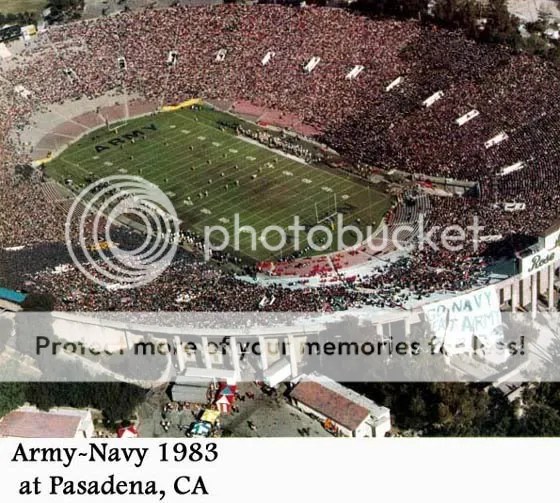


 The Birddog