Back To Business

What a whirlwind couple of days. Every time I’d sit down to write something, a new piece of news would break that would make my work out of date. And trying to separate rumors from facts was enough to keep me awake at night. Here’s a tip for the future: anyone who has “sources” for “inside information” isn’t going to post what they’ve learned on a message board. At least not if they want to keep those sources. Of course, I already knew this. But I still lost sleep over the whole thing. In the end, Paul Johnson left, and in his place stepped his #1 protégé, Ken Niumatalolo.

The announcement of Johnson’s successor came so quickly that I didn’t have a chance to finish my post endorsing Niumatalolo for the job. I think every Navy fan that wasn’t fooling themselves knew that Paul Johnson’s departure was going to happen eventually. Our hope was that Ken Niumatalolo would still be here when that day finally came. And for good reason– Niumatalolo is the right man for the job.

He is the right choice for the long term. It can’t be overstated how difficult it is to win at the Naval Academy. Navy hadn’t won a Commander in Chief’s Trophy since 1981 until Paul Johnson and his staff showed up. It would be foolish to alter a winning formula. Ken played for Paul Johnson. He entered the coaching profession because of Paul Johnson. He has run the offense on his own, without Paul Johnson. And when he wasn’t coaching with Johnson, he was with John Robinson. That’s one hell of a pedigree. It would be unfair to expect him to be Paul Johnson, but it would be unwise to pick an apple from a different tree. There are no guarantees that Niumat will match Paul Johnson’s success, but he deserves the chance to try. For his sake and for ours.

Niumat is also right for the short term. By making the decision quickly, Chet Gladchuk shows confidence in his new coach; confidence that is reassuring to the mids, and to recruits waiting for I-Day. It also helps for the Poinsettia Bowl. Now the mids aren’t just playing (and practicing) to beat Utah; they’re playing to make a good impression on their new coach. Chet deserves a lot of credit for pulling the trigger on this rather than dragging everyone, especially the team, through a dog & pony show.

Hiring Niumat right away was a tremendous relief for other reasons, too. I am afraid of who we might have ended up with if we ventured out too far. Chet made it very clear in the press conference announcing Niumat’s hiring: he was going after a triple option coach one way or another.

“Fundamentally, at Navy it’s going to be the triple option. That’s all there is to it,” Mr. Gladchuk said. “That is something I felt really strongly about. It’s an offense that has been really successful for us and given us that edge. If you look at who’s out there that can run the triple option, I consider Kenny one of the masters.”

I sort of figured that, and it made me nervous. You see, I am one of those freakish people that doesn’t believe that you need to run the triple option to win at a service academy (GASP). Don’t get me wrong; I love the triple option. Anyone who’s been reading this blog for any length of time knows that. But there’s more than one way to win. The key to winning at a service academy, in my opinion, is to be different. When you run a different kind of offense, you can recruit a different kind of player. Anything that expands the recruiting pool is a good thing, whether it’s the triple option or some other kind of unconventional offense.

My fear, then, was that we would look for option coaches instead of good coaches. Remember, Elliot Uzelac ran the option. Bob Sutton ran the option. Charlie Weatherbie continued to run option-ish offenses after PJ and Niumat left. They all got canned. Systems aren’t what win games; coaches are. Running a particular offensive system is one thing; knowing how to adjust within that system, recruiting for that system, and organizational skills are another. To say that the cause of Paul Johnson’s success is simply his offense would be a gross oversimplification, and doesn’t give the man enough credit. Fortunately, in Ken Niumatalolo we appear to get the best of both worlds. Time will tell.

The first order of business for Coach Niumatalolo is to assemble his staff. He was asked at the press conference if he intended to call the plays on offense like his predecessor, and he gave the somewhat surprising answer that it would depend on what his staff would look like. Yesterday, we found out why; according to the Honolulu Star-Bulletin, quarterbacks coach Ivin Jasper is staying at Navy and will be promoted to offensive coordinator. This is huge news. When Paul Johnson was the offensive coordinator at Hawaii and Navy, he sat up in the press box to get a better view of how defenses were adjusting to his play calling. When he became head coach, he had an assistant sitting in the press box watching the defense, allowing PJ to call plays from the sideline. There are only so many assistant coaches out there who really understand this offense. If Johnson took the entire staff with him to Georgia Tech, it might have been difficult to find someone new to put upstairs and tell Niumatalolo the information he needed to call the play from the sideline. But with Jasper staying, he will presumably call plays from the press box himself.

For Jasper, it’s a smart career move. If Johnson wins at Georgia Tech– and he will– then his offense is going to be in demand. Johnson calls his own plays, which means the only coordinator available to teams who want to copy Georgia Tech would be Ivin Jasper. We still haven’t heard any official announcement about Jasper’s new role and whether or not he’d still coach the quarterbacks. But the paper says that it came straight from Niumat himself, so hopefully we’ll get that word soon. There’s more good news in Bill Wagner’s blog as it appears that Buddy Green is also staying, with possibly all of the defensive coaches sticking around with him. Keeping this many assistants around is a big deal, particularly for recruiting. Nothing is official yet, but it would seem that things are going about as well as we could have hoped in this situation.

According to Wagner, Jeff Monken (slotbacks), Brian Bohannon (wide receivers), and Todd Spencer (offensive line) are likely to follow Paul Johnson to Georgia Tech. I think that fullbacks coach Chris Culton is a possibility too, although that is pure conjecture on my part and not the result of any inside knowledge. (You may be asking yourself how Todd Spencer and Niumatalolo both coached the offensive line– Niumat coached interior linemen while Spencer coached the tackles.) In theory, offensive assistants would be more difficult to find than defensive assistants, given the unique nature of the Navy offense. That might be true at some positions (offensive line) more than others (wide receivers). The best bet for offensive line coach might be NAPS head coach Mark Williams. Williams was an All-American guard for Paul Johnson at Georgia Southern, served as a graduate assistant for Tim Stowers at Rhode Island, then returned to Georgia Southern as the offensive line coach for Mike Sewak. Sewak himself could very well be joining Johnson at Georgia Tech. There are several Georgia Southern connections out there, such as Stowers himself or Brent Davis & Bob Bodine at VMI. But unlike most other Johnson assistants, Ken Niumatalolo never coached at Georgia Southern. Does he go a different route? And do we even structure our assistants the same way? It will be interesting to see who turns up in Annapolis.

It was disappointing to see Paul Johnson leave, but at the same time it’s exciting to see how Ken Niumatalolo will shape Navy football. After-practice press briefings, the bowl game, spring practice… I find myself looking forward to them even more now because I’m not completely sure of what to expect. Navy has changed coaches quite a few times over the last 25 years, and there’s always excitement and optimism associated with the event. But this time there’s a little bit of nervousness mixed in there because for once, we actually have something to lose.

The Logic of the Faithful

The nadir of my life as a Navy football fan– and probably the same for many of you– was the 2001 Georgia Tech game. My ship was the visit ship on the Yard that weekend, and I was excited to show off the Navy football experience to my division. They were a really great bunch, and we had spent a lot of time together on cruise sitting in the EM shop and talking college football. I bought them all tickets to the game, and after tailgating with my sponsor we claimed a spot on the hill to watch. It was a great day… Up until kickoff, anyway. Three hours or so later, as Damarius Bilbo ran a bootleg in from the 6 yard line to give the Yellow Jackets a 70-7 lead with 32 seconds left in the game, EM1 Shaw (now Chief Warrant Officer Shaw) turned to me with a smile and said, “Don’t worry, Mr. James. They had to put the game out of reach!”

I was absolutely miserable, and I wasn’t alone. The consensus at the postgame tailgate was that with a new athletic director in charge, we were watching Charlie Weatherbie’s last season in Annapolis. It was depressing; not just because of the losses, but because I liked Charlie Weatherbie. It isn’t like I knew him or anything. It’s just that he was the coach when I was a mid, and most of the best times I had at USNA involved the football, basketball, and lacrosse teams. I had nothing but fond memories of weird pep rallies and the Aloha Bowl when it came to Weatherbie. As the team languished through an 0-10 season, I had a hard time understanding how so much could go so wrong so quickly.

“So Much, So Wrong, So Quickly” would be a good name for a book on the history of Navy football for the two decades between 1981-2001. George Welsh’s last season in Annapolis was a fun one, with wins over Syracuse, Georgia Tech, and Air Force, and a comeback that fell just short in the Liberty Bowl against Ohio State. West Virginia offensive coordinator Gary Tranquill, who had coached Navy’s quarterbacks and receivers under Welsh from 1973-76, was hired to replace Welsh after he left to take the Virginia job in 1982. In the first game of the ’82 season, Tranquill beat his old boss, 30-16, in Annapolis.

It was all downhill from there.

Four different coaches tried to replicate Welsh’s success at Navy over the next 20 years. None of them succeeded. In 1996, however, there was a glimmer of hope. Navy went 9-3, including an Aloha Bowl win over California. When Charlie Weatherbie was unable to generate any kind of momentum from that season, Chet Gladchuk turned to someone else from that team to try to capture lightning in a bottle again: Paul Johnson. Johnson had gone on to win two national championships at Georgia Southern since leaving Navy after the ’96 season, and seemed like obvious choice… If he’d take the job. Chet wouldn’t take no for an answer. Paul didn’t like hearing that he couldn’t win at Navy. It was a match made in heaven. On December 9, 2001, Paul Johnson was named as the 36th head football coach at the U.S. Naval Academy.

Six years later, I’m finalizing plans for my trip to San Diego to see Navy’s 5th-straight bowl game. The superintendent of USNA at the time, VADM John Ryan, said of Johnson’s hiring, “I believe years from now people will point to December 9, 2001, as the day the Naval Academy turned around its football program.” How right he was. Five bowl games, five CIC Trophies, a 10-win season, a top 25 ranking, and a victory over Notre Dame later, and I’d say things have turned around. When you consider that it was fairly common for people to say that Navy should drop to I-AA, our success has been borderline miraculous.

Unfortunately, I can’t help but wonder if December 7, 2007, is what people will look back to as the day the Naval Academy’s football program went straight back into the toilet.

That’s pretty damn pessimistic, I know. But it’s a pessimism born from the respect I have for Paul Johnson. Navy is one of the hardest coaching jobs in all of college football, if not the hardest. The academic restrictions, military commitment, lack of redshirting, and school administration that can change on a dime would make most coaches want to schedule Navy, but never coach there. But as we already know, Paul Johnson isn’t most coaches. It was a special feeling to truly believe that Navy– Navy— had the best college football coach in America. And not just because of partisan chest-thumping, either. I felt that way because of what I saw with my own eyes. Unfortunately, it’s knowing that it took the best coach in football to even get to this point that makes me nervous about Ken Niumatalolo’s ability to maintain what we have. If anyone can, it’s Niumat; but it takes a special coach to win at Navy. Continuing at the level we’ve grown accustomed to is no guarantee. Paul Johnson leaving isn’t the end of the world… But it’s a distinct possibility.

I’ve written a lot about Johnson’s offense. It’s his trademark, and the first thing that comes to mind when his name is mentioned. Yet when you hear his players and other people associated with the program talk about him, they talk about so much more than just Xs and Os. They talk about his attitude. His demand for perfection. His one-liners. His recruiting. And then, oh by the way, he’s an offensive genius. Paul Johnson is a complete coach if there ever was one.

I know the temptation to be bitter is there, but if you didn’t see this coming then you haven’t been paying attention. Back in July, Johnson told CSTV that, “it’s intriguing to think that you’d have a chance sometime maybe to win a championship where it might be a little easier.” And that certainly wasn’t the first time he said something along those lines. So why the shock?

It comes down to something that I like to call the “logic of the faithful.” It’s a form of denial. When the rumor of a job opportunity comes up, fans start listing all the reasons why they think their job is better than school X.

“Duke is a coach’s graveyard! He won’t go there”

“Georgia Tech? They’re only the second-best team in their own state! They can’t get recruits away from Georgia!”

“SMU? That isn’t a step up from Navy! Nobody wins there!”

“Navy is special! He has it good here! Why would he throw that away?”

What people either fail or refuse to realize is that no matter what you say about these other schools, the same (or worse) was said about Navy when Johnson became the coach here. None of the options that he had in front of him were worse than the Navy job he took over. Coaching graveyard? Impossible recruiting? An 0-10 team that didn’t seem like a step up from a I-AA powerhouse? Check, check, check. But Coach Johnson didn’t see that. Instead, he saw what was possible and how to achieve it. And when people told him that he couldn’t do it, it made him mad enough to try. The same attitude that brought him to Navy is what is taking him to Georgia Tech. Johnson wants to win championships, and he wants to prove that his offense can do it. He sees that potential in Georgia Tech.

We’ve all made hard career decisions. It’s no different for Paul. I am extremely thankful for everything he did at Navy. No matter how bitter you might feel, all Paul Johnson did was make the Naval Academy a better place, and the Navy job more desirable on the college football landscape. He inherited a program doomed for failure, and has left it as a program expecting to win. If someone told you in 2001, after having gone 1-20 over the last two seasons, that a new coach would take us to 5 bowl games and 5 CIC Trophies before leaving 6 years later… Would you have taken it? You know you would. You know that the program needed a miracle in 2002. We got our miracle. His name is Paul Johnson. And now, as he tosses the keys to Ken Niumatalolo and goes on to pursue his dream, we owe him nothing but thanks.

I hope he reaches his goal of winning championships. And do any of you really doubt that he will?

The Future of Army-Navy


With Navy’s 6th straight win in the series, we’ve reached a new frontier in Army-Navy history. Until now, neither team had ever been able to string together this many consecutive victories. It isn’t the first big streak, though. Army won 5 straight from 1992-1996, and that was part of a longer trend as the Cadets (not the Black Knights back then) were 9-2 against Navy from ’86-’96. That followed a stretch from 1973-1985 where Navy had the upper hand, going 10-2-1 against Army. The Mids had two other 5-game win streaks; from 1959-1963, and from 1939-1943. Army didn’t lose a game to Navy from 1922-1933, although there were two ties over that span (including the 1926 “Game of the Century”). So while a winning streak this long is unprecedented, streaks in general aren’t unusual in the rivalry.

Unlike most of these other streaks, though, the wave that Navy is currently riding comes at a time where TV money dominates college football. Army and Navy are not immune to the need for cash to remain competitive, and one of their biggest sources of revenue is the Army-Navy Game. Does Navy’s winning streak make the Army-Navy Game less desirable to broadcasters? One could argue that Army’s winning streak from ’92-’96 came in the same TV money era, but those were all close, exciting, competitive games (Army won by an average of 2 points per game over that span). The average score during Navy’s current run is 40-12. Will the lopsided results of the last 6 years have an adverse financial impact on the Navy football program?

CBS outbid ABC for the rights to broadcast Army-Navy at the end of Army’s 5-year run, and that 10-year contract expires after next year. They bent over backwards to win back then, too. I mean, really, is there any other reason why you’d see Army-Navy basketball on CBS each year? It’s part of the Army-Navy football package. CBS made the bid for a good reason; back when they won it, Army-Navy was the only game in town. At least the only college football game, anyway. This was before conference championship games; Army-Navy’s main TV competition was college basketball. Since football is king in this country, it wasn’t much competition at all. From the Atlanta Journal-Constitution in 1989:

The Army-Navy football game has no implications on the national championship, but it’s the one game CBS can count on every year for a solid rating, even when the competition is a pair of basketball games including ranked teams. Judging by the overnight Nielsen ratings, Army-Navy blew away the basketball with a 7.7 national rating (9.8 locally) to 3.3 for ABC’s doubleheader between Duke-Michigan and North Carolina-Iowa and 2.7 for Oklahoma-Nevada Las Vegas on NBC.

Compare that to this year’s ratings, courtesy of Sports Media Watch:

College football ratings
8.3: BCS Selection Show (Sun., 12/2, 7:45 PM FOX); down 12% from ’06.
7.3: Big 12 Championship Game, OK/Miss (Sat., 12/1, 8 PM ABC); up 74% from ’06.
6.0: SEC Championship Game, LSU/TN (Sat., 12/1, 4 PM CBS); up 28% from ’06.
4.2: ACC Championship Game, VT/BC (Sat., 12/1, 1 PM ABC); up 5% from ’06.
3.8: USC/UCLA (Sat., 12/1, 4:30 PM ABC); down 54% from ’06.
2.4: Army/Navy (Sat., 12/1, 12 PM CBS); down 8% from ’06.

I can’t find a link, unfortunately, but I read last year that the ratings for the 2006 edition of Army-Navy were down 20% from 2005. The 2005 game was a big one, if you’ll remember. Army came in on a 4-game winning streak, including a win over Air Force. Navy was 6-4. Army played what many claimed was a tougher schedule, and there was a lot of talk about how Army had “caught up” to Navy and that the Black Knights were going to put up a better fight. There was a decent amout of hype surrounding that game. But the people who tuned in ended up seeing another Navy blowout. When 2006 rolled around, viewers apparently weren’t going to be fooled again. And that might be a problem when we take bids on the game next year.

There is a certain core group that will watch Army-Navy no matter what. People like the pomp & circumstance that surrounds the game. A lot of these types might not watch another college football game. But that group isn’t very big. College football fans appreciate a good rivalry, because they know that there will be drama when the game is close. It makes the game appealing even if both teams come into the game with losing records. But when the game isn’t close, those fans tune out. And lately, fans have been tuning out the Army-Navy Game. Fewer viewers mean less ad revenue. Maybe I’m imagining things, but I really felt like there were fewer commercials during the game this year. And half of those commercials came from one company (Jeep). If advertisers aren’t buying time during the game, then the game is worth less to broadcasters. If the game is worth less, then bids won’t be as high. And that goes straight to NAAA’s bottom line. (By the way, the Subway ad with the ref explaining a blown call and how he was going to do a “make-up call” in the second half was hilarious.)
Navy’s success is paying dividends in season ticket sales, bowl games, and CSTV. But if we don’t want Army-Navy to dry up, then Army needs to get better soon.

Future sites: The other big part of the future of the game is where it will be played. After its second trip to Baltimore in 7 years, the game returns to Philadelphia in 2008 and 2009. Cities will soon start bidding for the next round of games beginning with 2010. Last time around, 16 cities from Miami to Boston to Seattle to San Antonio explored the possibility of hosting Army-Navy. The cost of transporting 8,000 midshipmen and cadets, though, limited the number of candidates with a relistic shot at winning. Nevertheless, I expect roughly the same number of cities to at least explore the possibility of bringing Army-Navy to town.

I believe that the game belongs in Philadelphia. I think that being associated with a single city adds to the name-brand recognition of the game, like a bowl game. Being located halfway between Annapolis and West Point makes obvious sense for season ticket holders at both schools for whom the Army-Navy game is the crown jewel of their ticket packages. The only thing that would change my mind is if Philadelphia started taking the game for granted again. Any more cardiologists’ conventions booking up all the hotel rooms or stadium railing held up by duct tape, and it’d be time to shop around. But the city really poured it on with their bid last time, and it certainly seems unlikely that they’d make the same kinds of mistakes again.

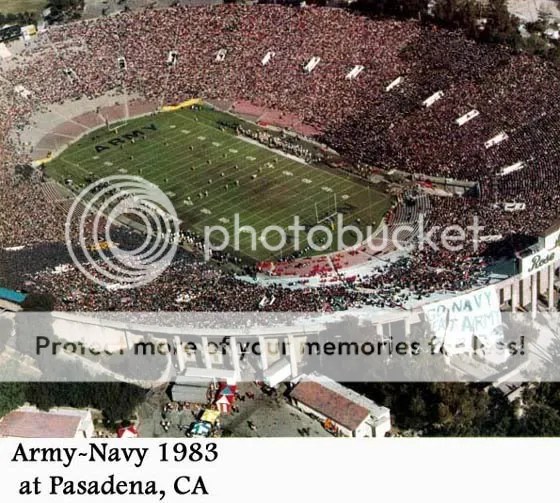
I know a lot of people want Army-Navy to be a sort of college football roadshow, moving to a different site around the country every few years or so. It is, after all, the “nation’s rivalry.” I can understand the sentiment, but I don’t agree with it. We talk a lot about the value of playing a “national schedule” so as to promote the Naval Academy in different parts of the country. But it isn’t really the games themselves that promote Navy; it’s the week of media coverage leading up to the game. When Navy goes to, say, Durham to play Duke, there might be 15-20,000 people actually at the game. But there are probably 100-200,000 people who will read the area’s newspapers. And when a visiting team comes to town, that means that the paper will be writing about them for a week. That’s where the value of playing a national schedule comes in. It’s so people in North Carolina and Texas and wherever can read about Zerbin Singleton, Antron Harper & co. Local media exposure helps to tell the Naval Academy story. But the Army-Navy game draws national media attention no matter where it’s played, so there’s little to be gained by moving it. The value of shipping the game around, in terms of exposure, certainly doesn’t outweigh the costs. And while both Army and Navy have fans and graduates all over the place, it’s a much simpler process for those folks to take a trip to the game than it is to move the game to them. The 1983 game at the Rose Bowl was allegedly a financial disaster.

Those of you who enjoyed the game in Baltimore, don’t hold your breath about seeing it there again anytime soon. Then again, a lot of attitudes can change in two years.

Opposite Day

The recurring theme for Navy football in 2007 has been the dominance of the offense coupled with the struggles of the defense and special teams. In the one-game season that is the Army-Navy game, however, the opposite was true. Navy’s defense turned in its best performance of the year, and perhaps the best performance in the Paul Johnson era, as Navy thumped Army 38-3. As you’ve no doubt heard, the win is Navy’s 6th in a row over Army, the first time in the 108-year old series that one team has been able to string that many victories together. That Navy won by 35 is no surprise, given the recent history of the rivalry. How they won, though, was.

Do you remember the 2005 Army-Navy Game? The Mids got off to a slow start in that game, too. Army actually took a 3-0 lead into the 2nd quarter, having kicked a field goal with 26 seconds left at the end of the 1st. On the next drive, though, Reggie Campbell took a pitch from Lamar Owens at midfield and blasted past the entire Army defense on the way to the end zone. The speed difference was so obvious between the two teams on that play that, despite the slow start, I knew that there was no way Army was going to win. The speed difference was amplified on the first play of the 4th quarter, as Adam Ballard– a fullback, remember– outran Army’s defensive backs on a 67-yard touchdown run of his own. On Saturday, as I watched Zerbin Singleton pull away from the Army secondary on his 38-yard touchdown run, I had the same feeling that I did in 2005. It’s an article of faith for Army fans that their players are just like Navy’s, and that if they ran the option they’d be just as good. It isn’t true. Navy is better, and it isn’t just the offense. Winning the game by 35 points, even when the offense had its least productive day of the season, tells us something.

During practice last week, Buddy Green had a message for his players. Play well against Army, he said, and people will forget the rest of the season. The defense responded. Navy  gave up a scant 217 yards of offense and forced two fumbles. The stat of the day was Army converting only 1 of 12 3rd-down opportunities. Of Navy’s 38 points, 24 were set up by the defense or special teams. Reggie had a 98-yard kickoff return. Shun White ran in a toss sweep for a TD after Michael Walsh forced a fumble that was recovered by Irv Spencer inside the Army 10 yard line. A blocked punt in the 4th quarter gave Navy the ball inside the Army 10 again, and set up Jarod Bryant’s 1-yard TD plunge. And Joey Bullen kicked a career-long 51-yard field goal to end the first half, which was set up by a brilliant punt return, again by Reggie Campbell. It was a tremendous performance from the defense and special teams. It feels really good to be able to say that, too, after the criticism (however justified) that those units have received all year.

I’m trying to decide where this defensive performance ranks among others during Buddy Green’s tenure as defensive coordinator. I really think it’s #1. There have been other memorable games for the defense; shutting out Tulsa in 2004, the big plays in the Emerald Bowl, the Stanford & Temple games last year, putting the clamps on Rice a couple of times… But I think this one was better. First, it’s the biggest game of the year. Yes, Army’s offense isn’t good, but it’s still the Army-Navy Game. This is still the one that matters the most. Second, unlike most of those other games, the offense didn’t have a great day. It was the defense that carried the team. The only other game among those I listed where you can say that is the 14-13 win over Rice in 2004. But this was done on the big stage, in the most important game. That’s what sets it apart for me.

So what was it with the offense anyway? Did they just have a bad day, or has John Mumford solved the puzzle of PJ’s offense? I watched the game again yesterday trying to figure out what Army did, and I really couldn’t see anything unusual schematically. Army did do two things that really slowed the running game down. They shed blocks as well as any team we’ve faced this year. They also had their safeties overcommit to the run. I mean really commit. Jordan Murray had 16 tackles. Usually, seeing that would be an invitation for PJ to throw it over their heads. But with the weather being what it was– cold and windy– and the defense playing as well as they were, I think Coach Johnson just decided not to bother with it. PJ said after the game that the weather wasn’t very conducive to passing, and Kaipo only had 5 attempts on the day. Only one of those attempts was a real home run swing. As lights-out as the defense was, I think PJ figured the only way that Army would get into the game was if they generated some turnovers. Throwing the ball on a windy day like that would have made turnovers a real possibility, so he just played things close to the vest. The good news is that Navy walked out of there with a dominating win, and didn’t have to put anything special on film to do it.

A disturbing backstory to the game was the conduct of some Army players on the field. You might have read this article from Bill Wagner where Adam Ballard talks about guys twisting his legs at the bottom of the pile. Other than seeing Adam get up angrily after a few tackles, that was hard to see on TV. What wasn’t hard to see, though, was Jeremy Trimble’s hit on Ram Vela after Army’s first play from scrimmage. Do you remember when Virginia tackle Brad Butler took a shot at Boston College DE Mathias Kiwanuka a couple of years ago? It looked like that; a shot at Vela’s knees from behind & to the side, and after the play was over. I have never wished to have my computer fixed as much as I do right now, just so I could capture the video and show it to you. If you recorded the game, look at the bottom of the screen on Army’s first play. It might be the dirtiest play in the history of the Army-Navy Game. Not that it’s a series known for dirty plays or anything, but that just makes it more shameful. Seriously, watch the tape. This isn’t hyperbole.

But no amount of shadiness was going to put Army over the top on Saturday. In the end, Navy sang their alma mater last, conducted by a seemingly reluctant Reggie Campbell. Hearing the Brigade chant his name, and more or less force him to the conductor’s podium, is a memory that I will never forget from this game. To see the Brigade connect with a player like that, and the team as a whole, is something that would have been almost unimaginable when I was at USNA. It’s a change for the better.

Birddog Game Balls

Reggie Campbell: Duh. But really, how much are we going to miss Reggie? What a special player. He is now second only to Napoleon McCallum among Navy’s all-time leaders in all-purpose yardage. Think about that for a second.

Michael Walsh: No player has improved more over the course of the season than Michael Walsh. He had yet another solid game against Army, with 8 tackles (2 for a loss) and a forced fumble that would set up a touchdown. Walsh has become Navy’s best defensive lineman. He’s only a junior, too.

Joey Bullen: Death. Taxes. Huge Joey Bullen field goals in big games. It’s science.

Alton Grizzard

The Army-Navy game is today. It’s one of the most celebrated days of the year. But today is also December 1; 14 years ago today, Alton Grizzard was killed. Please take a moment today to remember him.

I remember the first time I saw Alton Grizzard. I was 10 years old, and I had just moved from San Diego to Virginia Beach. We finally lived close enough to Annapolis to get to a Navy game. So I was with my father at my first Navy game, and Navy’s offense took the field. My father started to chuckle. I asked him why he was laughing, and he said something about one of the linebackers being lost. Alton definitely looked like a linebacker with that big ol’ neck roll he wore. That neck roll was a symbol of the toughness that he brought to the quarterback position and a sign of things to come.

What are your favorite Alton Grizzard memories?

False Start

There’s a blog I like to read called Coachspeak. It hasn’t been around long– only a few weeks, actually– but I find myself checking it every day. I’m not particularly drawn to the subject matter, as everything there seems to revolve around Texas A&M. Instead, I just find his approach to be entertaining. This is his “About” page:

I am a former sports writer. I’ve worked for several major newspapers mainly in the South and Southwest. I quit that job after getting disgusted about the emphasis placed on speed over accuracy.

This is my blog to sort out the facts from the rumors regarding the college football world. I will only write about the information I get from sources whose credibility I have relied on for years.

It doesn’t mean I’ll be right every time. But I’ll come closer than most of what you’re reading in today’s newspapers.

Speed valued more than accuracy? Say it ain’t so! Some of the comments on there are kind of funny, chock full of A&M fans with their own “sources” who talk about Steve Spurrier’s move to College Station as a done deal. But the author deflects all that, and had them on the trail of Mike Sherman from the beginning. Along those same lines, while Dennis Dodd wrote of imminent announcements and the pressing concerns of both Navy and SMU officials, Kate Hairopoulos of the Dallas Morning News applied a higher standard to her work and discovered that:

Navy spokesman Scott Strasemeier said no schools have asked permission to speak with Johnson.

It appears that we have stumbled head-first into just the kind of situation that the Coachspeak author described. Not that we’re out of the woods or anything, but what used to be called news has devolved into nothing more than dressed-up rumors. Navy fans have known for a while that no Navy football news is really news unless it comes from the notebooks of Bill Wagner, Chris Swezey, or any of the other writers that have reported for the Capital, Post, Sun, Times, or Examiner over the years. Yet for some reason, when another Paul Johnson rumor hits the misinformation superhighway, we have a collective seizure. Well, maybe some of you don’t, but I don’t think I’m alone. One would think that we would learn when someone’s crying wolf, but we never really do, even with a job like SMU that doesn’t seem to make any sense on the surface. (I can make a case for SMU, but I’ll save that for later.)

Can you blame us for panicking, though? We all know how much Paul Johnson means to the school. Yes, the school, not just the football team. Winning games is good for USNA. It brings the Navy family together. I’ve never seen 20,000 Navy grads and their families come to Annapolis for any academic or military event, but they’ll travel to all corners of the country to go to a bowl game. Winning gets USNA on TV, which helps the school send its message. Bowl games, the CSTV contract… both are thanks to Paul Johnson. And don’t underestimate what that exposure can do. Boise State saw a 135% increase in online admissions inquiries following their Fiesta Bowl win; their graduate school saw even more. Appalachian State had a 20% increase in applications after its second consecutive I-AA national championship. After their run to the Final Four, George Mason found itself to be a popular stop for high school students and their parents making decisions on which school to attend. Combine the Notre Dame win with a nail-biting overtime victory against Pittsburgh on ESPN, sprinkle in 5 consecutive bowl games, and top it off with every home game being shown on CSTV, and the Naval Academy sends a powerful message of its own. Appalachian State chancellor Kenneth Peacock said it best:

“Athletics is the front porch of your institution,” Peacock said. “Well, people have liked the front porch. They’ve stopped and looked.”

More exposure leads to more applications. More applications create a greater pool of candidates to choose from. Having a larger pool to choose from means that USNA can have even higher admissions standards. Higher standards lead to better Navy and Marine Corps officers. Better officers make the Navy and Marine Corps– indeed, the country– stronger.

Paul Johnson isn’t just a great football coach. He’s great for America.

Therefore, the only logical conclusion that one can make about athletic directors trying to hire Paul Johnson away is that they hate America. And I seriously doubt that Paul Johnson would want to coach at a place where they hate America. Obviously the reports that you hear about Paul Johnson being a candidate at other schools are all lies. LIES. So take a deep breath. We’re going to be OK.

It’s a good thing too, because winning at Navy isn’t something that just any coach can do. Good coaches have come to Annapolis and failed. Elliot Uzelac had 5 winning seasons in 7 years at Western Michigan. George Chaump averaged a little more than 8 wins a year at Marshall. No matter what happened at Navy, these guys were established coaches. They quickly learned that being a good coach is unfortunately not the same as being the right coach in Annapolis. Paul Johnson is the right coach.