Loose Change 1/25/08

Odds & ends you may have missed over the past week:

The State of Service Academy Football: Navy

If there is a theme to this “State of Service Academy Football” series this year, it’s change.

Army dealt with a head coaching change last season, and a new offense– whatever it may be– is on the horizon for 2008.

Air Force had to replace a legend in 2007, and will head into spring practice with one of the youngest teams in school history.

And then there’s Navy. With five head coaching switches in the last 20 years, change isn’t exactly unusual at the Naval Academy. What’s unusual this time around are the circumstances; for the first time since George Welsh left for Virginia, a Navy coach moved on because someone else actually wanted him. And with six years of accomplishment at a school where accomplishing anything is extraordinarily difficult, it’s no surprise that someone finally bit the option bullet and went after Paul Johnson.

Biting that bullet probably became a whole lot easier after this season too, not that Johnson’s record as a head coach shouldn’t have been enough to get the attention of college football’s big names. With Navy’s defense taking an inexplicable nose dive, it was up to Johnson’s offense to come up big if Navy was to have any chance of winning. And great googly moogly did they ever. Navy became the first I-A team in history to lead the nation in rushing for three consecutive years. They were 22nd in total offense as well, and finished in the top 10 in scoring offense– all with players that most I-A schools wouldn’t even sniff at. Navy walked away with wins at Pitt and at Notre Dame, two teams that even in their worst years would never trade the talent on their roster for that of Navy’s. The Mids won their 5th straight Commander-In-Chief’s Trophy, went to their 5th straight bowl game, and was the victor in the highest-scoring game in I-A history. A few ADs finally figured it out. The 5 teams ranked directly behind (!) Navy in scoring offense in 2007 were LSU, Oregon, Arkansas, Texas, and Kentucky. Those are the kinds of names with which schools like Georgia Tech would like to be mentioned; and if Paul Johnson could do it at Navy, it’s difficult to comprehend the kind of carnage he’ll leave in his wake with access to ACC talent.

Difficult to comprehend, but imminent nevertheless as Johnson left for Georgia Tech after a week of barnstorming between Annapolis, Dallas, and Atlanta. Now that the inevitable has happened (I’m still amazed that it actually took 6 years), Navy is looking to regroup under new head coach Ken Niumatalolo.

The first question on every Navy fan’s mind is, “What’s going to change?” Niumat’s answer comes straight from the “ain’t broke and not gonna fix it” department. In a podcast with CSTV’s Greg Amsinger, Coach Niumat said that some things might evolve as it’s up to him to handle various situations in his own way over time, but he isn’t looking to do anything differently right off the bat. Of course, that’s not entirely true. The most obvious departure from Paul Johnson’s formula is that Niumatalolo won’t act as his own offensive coordinator. That honor falls to Ivin Jasper, the quarterbacks coach under Johnson who along with Niumatalolo was one of Johnson’s top two offensive assistants; and it’s in playcalling that we find the most immediate change under Niumatalolo.

While I was in San Diego for the Poinsettia Bowl, someone talked to me about what I thought was a very interesting point. How many games over the last 6 years did Navy win almost entirely because of Paul Johnson’s playcalling? Just look back at 2007, with plays like the two QB draws at the end of the Duke game, or bringing in the wide receivers tight to the formation against Notre Dame, or calling plays we’ve never seen before in the Northern Illinois game; Paul Johnson always seemed to know exactly what adjustments to make. That, and he had an incredible memory. Ask Coach Johnson why he made a particular adjustment in a game, and he would probably say something along the lines of, “Well, Middle Tennessee tried the same thing against us on defense back at Southern in ’86 and I didn’t really have an answer for it. But I saw it again when we played Middle Tennessee in ’93 and I was at Hawaii, and we were ready. I just did the same thing here.” Johnson’s memory for detail made him a sort of football savant. He knew what to do because in the 20+ years that he has been running this offense, he has seen every possible way a defense can line up against it.

But there’s the rub. Johnson has seen defenses line up against this offense for two decades. Ivin Jasper and Ken Niumatalolo have not. The two of them are as well-versed in the fundamentals of Paul Johnson’s offense as anyone other than maybe Mike Sewak, but do they have the same mastery of adjusting on the fly? Maybe, maybe not. Both have had the chance to run offenses on their own before; Niumatalolo replaced Johnson as Navy’s offensive coordinator in ’97, and Jasper ran the offenses at both NAPS and Indiana State. There’s no doubt that the two of them have picked up on some things, but 20 years of experience is hard to replace. It isn’t unreasonable to assume that there will be a learning curve as Niumat and Jasper take charge. That doesn’t have to mean disaster, of course; Navy was 7-4 in 1997, and Georgia Southern won two national championships in PJ’s first two years as offensive coordinator.

Other than the delegation of playcalling duties, the other obvious change is that there are four new assistant coaches on the staff and some reassignments of coaches who are returning. Jasper is not only the offensive coordinator, but he will retain his duties as the quarterbacks coach and coach the fullbacks as well. Jasper coached both positions at Georgia Southern and in his previous stint at Navy, so the move is a natural one. Chris Culton moves from fullbacks to the offensive line, a position he coached for Tim Stowers at Rhode Island. Niumatalolo will continue using two offensive line coaches, and Culton will be joined by another former Rhode Island offensive line coach, Ashley Ingram. Ingram spent last season as Bucknell’s offensive coordinator. Another I-AA offensive coordinator also joined Niumatalolo’s staff as Joe DuPaix left Cal Poly to coach the Navy slotbacks. Danny O’Rourke moves from defense to offense, replacing Brian Bohannon as the wide receivers coach. On the defensive side of the ball, Steve Johns fills the void left by O’Rourke at inside linebackers. Tony Grantham returns to Annapolis to join Keith Jones in coaching the outside linebackers. Justin Davis is now assisting with the defensive line.

DuPaix and Johns appear on the surface to be great hires. DuPaix’s offense led all of I-AA last year in total yardage, and he was considered to be a front-runner for the head coaching job at his alma mater, Southern Utah. But DuPaix’s biggest shoes to fill might not be in coaching players, but recruiting them. Bill Wagner makes the excellent point that DuPaix is taking over Todd Spencer’s recruiting area in Texas. Spencer had been recruiting Texas since Paul Johnson’s first stint in Annapolis and had built several contacts over those 11 years. Not coincidentally, the Navy roster is loaded with Texans every year. It will be up to DuPaix to make sure that things stay that way.

For Johns, recruiting is apparently right in his wheelhouse. Coach Niumatalolo was responsible for west coast recruiting under Johnson; now that he’s taken over as head coach, that area of responsibility will fall to Johns. Johns came to Navy from Grossmont Junior College, a national JUCO powerhouse. According to Wagner, Niumat feels that Johns’ time there, coupled with his six years as UNLV’s recruiting coordinator, has helped him build relationships with area high school coaches. While Navy hasn’t packed its roster with west coast players, they have had their share of impact players from the region– guys like Kaipo, John Chan, and Marco Nelson. It’s a valuable pipeline.

On the player side, the biggest losses are on the offensive line and Reggie Campbell. The core group of Kaipo, Eric Kettani, and Shun White are as good a returning group as the Mids have had for a while, but their performance in 2008 will depend on how well Navy can replace one of the best offensive lines ever to play in Annapolis. Anthony Gaskins returns after starting all year at guard, but I wouldn’t be surprised to see him move to center in the spring. It could be one of many position changes as the coaches try to find the right mix of players up front. On defense, just about everyone returns. Irv Spencer won’t, obviously, but Clint Sovie will after missing most of 2007. Jeff Deliz will too. How effective Sovie and Deliz will be after their injuries is a big question mark. The defense as a whole played its best games at the end of the year, so it’s easy to be optimistic about how they’ll do next year. Maybe too easy.

The biggest obstacle facing Navy next year might be their schedule. With trips to Ball State, Duke, and Wake Forest, and a home game against Rutgers squeezed in the middle, it isn’t hard to imagine Navy being 1-4 going into the Air Force game. And even that game is on the road, followed up with home dates against a more mature Pitt team than last year and an SMU team that will now be coached by June Jones. All subject to change, of course… But as it stands right now, that’s no cakewalk. It’s possible that the team could be better next year but still end up with a worse record. Keep that in mind when you set your expectations. Navy should still win the Commander-In-Chief’s Trophy again next year assuming that everything keeps humming along under Niumatalolo the way they did under Johnson. But it’s reasonable to expect some growing pains.

The Case for Hawaii

It didn’t take long.

After Georgia did pretty much whatever it wanted in a 41-10 win over Hawaii on Tuesday night, you just knew that people were going to start saying that Hawaii didn’t deserve to be in a BCS game. I haven’t seen entire columns dedicated to the subject yet, although I’m sure they’re coming. But we’re already seeing little comments sprinkled in here & there, such as in this Boston Globe piece: 

After their win over Illinois, which like Hawaii was not worthy of a BCS bowl, the Trojans were feeling confident.

And of course there’s the usual sniper shots aimed at Hawaii coming from the blog & message board world. That’s no surprise. Unfortunately, those who share this sentiment have fallen victim to the greatest fallacy in college football: that “deserve” has anything to do with the BCS. The BCS isn’t about competition. It isn’t about matching up the best teams to produce the most entertaining games. It is about one thing and one thing only: money. No, this isn’t going to be one of those cynical, oh-noes-there’s-money-in-college-football sermons. We all know that college football is a business, and I don’t lament that. I’m just putting Hawaii’s Sugar Bowl bid in the right perspective.

The BCS is the result of an evolutionary process that began in 1990. Colorado and Georgia Tech shared the national championship that year, as the Buffaloes were #1 in the AP Poll while Tech sat atop the Coaches’ Poll. The situation repeated itself the following year, as Washington and Miami each went undefeated and claimed a #1 spot in one of the two major polls. With two consecutive years of a split national championship, there was significant demand among college football fans for a way to determine a “true” national champion and end the phenomenon of split titles. Where there’s demand, there’s a business opportunity. The ACC, Big East, SEC, SWC, and Big 8 conferences, along with Notre Dame and 6 bowl games, looked to capitalize on that opportunity by forming the Bowl Coalition. The basic premise of the Bowl Coalition was that creating a #1 vs. #2 matchup in the Cotton, Orange, Fiesta, or Sugar Bowls would be a cash bonanza, as demand for the game would drive television money through the roof. (The Rose Bowl, along with the Pac 10 and Big 10, chose not to be involved and instead elected to maintain their traditional affiliations). The way the Bowl Coalition worked was that three conferences– the SEC, SWC, and Big 8– would maintain their traditional bowl tie-ins, sending their respective champions to the Sugar, Cotton, and Orange Bowls. If the champion of one of those three conferences was ranked in #1 or #2, their affiliated bowl would host the championship game. If both #1 and #2 were out of the SEC, SWC, or Big 8, then the team ranked #1 would play in their conference’s affiliated bowl, and the #2 team would be released from their traditional game to play the #1 team. If neither #1 or #2 was from one of those three conferences, then the championship game would be played in the Fiesta Bowl. The remaining slots for Bowl Coalition games would be filled by the ACC champ, Big East Champ, runners-up from the five coalition conferences, and Notre Dame. The third-place team from the SEC would go to the Gator Bowl.

The Bowl Coalition lasted for 3 years, ending in 1994. In its place came the Bowl Alliance. The premise of the Bowl Alliance was the same, but the rules were adjusted from those of the Bowl Coalition. The major rules changes were that the traditional affiliations between conference champions and bowl games were dissolved, the Gator and John Hancock (Sun) Bowls were no longer affiliated (leaving only the Cotton, Orange, and Sugar Bowls), and two at-large bids were available to teams that met certain eligibility requirements. The at-large bids were possible because of the demise of the Southwest Conference, and because Notre Dame was no longer guaranteed a spot (thanks to a 6-4-1 season in 1994). The Rose Bowl, Big 10 and Pac 10 were still not involved. The Bowl Alliance could not produce a consensus national champion in 1997 thanks to Michigan’s undefeated season and subsequent Rose Bowl berth, which precluded a matchup with the country’s other undefeated team that year, Nebraska. Both teams won their bowl games and shared the national championship, with Michigan atop the AP Poll and Nebraska taking the Coaches’ Poll. It became obvious that without the inclusion of the Big 10 and Pac 10, the legitimacy of the Bowl Alliance “championship game,” and by extension its television value, was in doubt. A solution needed to be reached in order to maintain the game’s appeal. The members of the Bowl Alliance made concessions to the Rose Bowl, allowing it to keep its own television contract and maintain its Pac 10-Big 10 matchup in years that neither conference’s champion is ranked #1 or #2. With that, the Rose Bowl, Pac 10, and Big 10 entered the fold, and the Bowl Championship Series was born.

The BCS consolidated the Orange, Sugar, and Fiesta Bowls into one television package. The BCS Championship Game was added to this package after that game’s creation. Combining these games meant that one television network would be able to control the broadcasting rights for all of the major bowl games– a very valuable proposition. The combined value of the BCS games was more than the sum of its parts, allowing these games to give payouts far greater than ever before. But the rules were such that even if there was a demand for a team outside of the BCS conferences, it was far more difficult for that team to qualify for a BCS game and get access to this money. Under the old rules, a non-BCS conference school had to finish in the top 6 of the BCS standings to get an automatic berth. That is a much higher ranking than several BCS conference champions have had. The revenue created by the BCS was distributed amongst conferences that make up roughly half of all Division I-A teams. That isn’t necessarily bad in itself; that’s just capitalism. But structuring the system to ensure that bowl money is consolidated among a privileged group regardless of their performance is unfair. The BCS was essentially a monopoly, tolerated under the guise that it was all for the sake of creating a national championship matchup.

One look at the BCS rules and it’s obvious that the system has little to do with finding a champion and everything to do with money. The rules only make sense if you understand that. If the BCS was just about finding a national champion, then there wouldn’t be a need for the standings to matter beyond the #1 and #2 teams. After the top two teams were selected for the championship game, the rest of the bowls would be able to pick whatever team they wanted regardless of BCS ranking. The BCS isn’t about setting up good games to watch, either; if that was the case, then you’d just take the top 10 in the BCS standings and have them play 1 vs. 2, 3 vs. 4, 5 vs. 6, etc. And why do you think that no conference is allowed to put more than 2 teams into the BCS? It’s so money is distrubited more or less evenly between BCS conferences, with no one conference hogging it all. If good football was the BCS’s motivation, then it would be no problem to have, say, 3 Big 12 teams in BCS games if they were the best teams available. For that matter, if the goal is to create the best matchups, then why even have automatic bids? Was Pitt one of the best teams available in 2004? They played in the Fiesta Bowl as Big East champions, but Navy actually finished ahead of them in both polls. How about a 4-loss Florida State team going to the Sugar Bowl as ACC champions in 2002 while Texas (10-2), Kansas State (10-2), and Notre Dame (10-2) were left out of the BCS? Or 1998, where 8-3 Syracuse won the Big East and got an Orange Bowl bid ahead of higher-ranked Arizona (11-1), Tulane (11-0), Air Force (11-1), Kansas State (11-1), and Georgia Tech (9-2)? Did they earn these BCS berths by virtue of their conference championship? Maybe, but that doesn’t mean that an 8-3 or 9-4 conference champ makes for a better game than undefeated Tulane or 11-1 Arizona. Pitt, Florida State, and Syracuse got those spots because the Big East and the ACC expect to get their share of the pie.

It’s this monopoly that Tulane University president Scott Cowen sought to break when he organized non-BCS university presidents into the Presidential Coalition for Athletics Reform in 2003. Cowen’s organization focused on two main issues; the first being access to and distribution of BCS money, and the second being the impact of negative perception that comes with being branded as a “non-BCS” school. Cowen’s organization met with BCS conference officials in 2004, and the result was the BCS system that we have in place today; a fifth BCS game and more accessibility for conferences outside of the 6 automatic qualifiers. Which brings us back to Hawaii.

The overwhelming concern of non-BCS schools was that the domination of bowl money by BCS members would create a de facto subdivision within Division I-A. BCS schools were generating enormous amounts of money and investing it in themselves, starting a sort of arms race of facilities, recruiting budgets, and coaches’ salaries. It’s a race in which schools on the outside of the BCS cash stream cannot compete. There might not be two better schools to illustrate this divide than Hawaii and Georgia. Take a look at Georgia’s football locker room. Heck, forget football… Take a look at what Georgia has for women’s basketball. Now compare that to this article in the Honolulu Advertiser in which Colt Brennan makes a plea for soap– soap–for Hawaii’s football locker room. Or consider each school’s recruiting budget. At Georgia, it’s half a million dollars. At Hawaii, June Jones couldn’t even afford to take trips to the mainland with his $50,000 recruiting budget— one-tenth of Georgia’s. Of course, not every team outside of the BCS conferences is in the quite the same financial situation as Hawaii. But they really aren’t that far from it.

And that’s the point. People are going to say that Hawaii didn’t deserve to be in the Sugar Bowl because they weren’t nearly as good as Georgia. Of course they weren’t. They weren’t supposed to be. Non-BCS schools didn’t get increased access to BCS bowls because they are good. They got increased access to the BCS to help them get good. Or at least to help them buy some damn soap. Now that’s not to say that there aren’t any teams outside of the BCS good enough to match up with the Georgias of the world. Non-BCS schools have still won more BCS bowl games than the ACC has. But with the enormous gap in resources between the automatic qualifiers and the outsiders, that success rate won’t last forever. The BCS generates about $100 million annually which gets divided between all I-A institutions. In most years, the BCS conferences get $91 million of it. Controlling that much of the money pie each year by rule virtually ensures that the BCS conferences will remain on top forever. I know what you’re thinking; they would always be the top conferences anyway, right? Maybe, maybe not. What if the BCS system was implemented 30 years ago? The Big East and Big 12 wouldn’t exist, the Southwest Conference would still be a powerhouse, Miami and Virginia Tech would probably be in Conference USA, and the Fiesta Bowl would still be a glorified Arizona State home game. Change did happen when schools and conferences competed on equal footing, but with non-BCS conferences only getting 9% of the money to split between themselves, it’s hard to imagine anything other than the status quo. Under the new BCS contract, an additional 9% is given to the non-BCS conferences when one of their teams play in a BCS game. That won’t be enough to turn the WAC into the Pac 10, but with a little bit of innovation, some of those schools can stretch their dollars enough that they can at least find ways to compete with the big boys once in a while. Who knows? With the estimated $3.5-4 million that Hawaii is expected to receive from their Sugar Bowl appearance, maybe they could afford soap and shampoo. 

As a fan, I was thrilled to see Hawaii in a BCS game. I wanted to see how they stacked up. Sure, Georgia could have played some 2 or 3-loss BCS team and perhaps gotten a better game out of them. Big deal. We see games like that every single year. It would usually be a more evenly matched game, but it would rarely be a better story. I hate seeing the little guy putting together a dream season only to be left wondering “what if” at the end of the season. I guess people just don’t like rooting for the underdog anymore. Besides, going into this year there have been 10 BCS bowl games that resulted in blowouts of 20 points or more, including losses by teams like Oklahoma, Ohio State, Iowa, and Nebraska. Were those teams undeserving of a spot in the BCS? Good games are no guarantee when you put big names in a bowl game.

If you’re a Navy fan, you should root like hell for teams like Hawaii to get a BCS berth. If Navy ever does the impossible and gets to a BCS game of its own, the Mids’ schedule is probably going to look a lot like the Warriors’. People will be talking about about whether or not Navy deserves to be there, too. Pray that we one day get a chance to defend a Navy spot in the Orange Bowl.

The Birddog Postseason Football Awards

It’s time for the first annual Birddog Navy Football Awards. They won’t get you a sword or a watch at the football banquet, but they’re easily the most prestigious Navy football awards to come out of Jacksonville. The players got digital camcorders from the Meineke Car Care Bowl and PSPs from the Poinsettia Bowl, but from The Birddog they get praise from an internet fan. And we all know that’s what really matters. I don’t have a name for these awards yet like the “Birdies” or the “Doggies” because I figure that having a blog already makes me enough of a nerd. If you can come up with a name that doesn’t suck, please don’t hesitate to suggest it. I won’t hold my breath. Anyway, on with the superlatives.

Offensive Player of the Year

QB Kaipo-Noa Kaheaku-Enhada

This one is a no-brainer. When the offense has to be perfect in order for the team to have a chance to win, it puts tremendous pressure on the quarterback. Kaipo didn’t just get by in these conditions; he thrived. He had long touchdown runs against Temple, Ball State, and Air Force. He threw the ball all over the place against Duke. He was unflappable against Notre Dame. His game against Pittsburgh might have been the most complete performance by a Navy quarterback in a generation, with 122 yards and a touchdown rushing on top of 9-12 passing for 166 yards and two more touchdowns. For the season, Kaipo ran for 834 yards and 12 touchdowns while adding another 952 yards through the air and 8 touchdowns.

But it isn’t individual statistical dominance that sets Kaipo apart. What makes Kaipo special is his mastery of the finer points of Paul Johnson’s offense. Kaipo might be one of the most underappreciated players in Navy history. He does all the little things that you can’t really see. Things like reading the body positioning of the pitch key to tell if it would be better to fake the pitch than give it to the slotback. Things like understanding the big picture of the offense. Things like staying in Annapolis all summer to run pass skeleton drills, which led to a 154.46 pass efficiency rating. Under Kaipo’s direction, the Navy offense broke a 90-year old school record by scoring 497 points. Good thing too, because anything less would’ve resulted in a very different season for the Mids.

Kaipo is Navy’s best option quarterback since Chris McCoy. If the offensive line can pick up next year where they’ve left off, then one day we’ll be talking about someone being the best Navy quarterback since Kaipo.

Defensive Player of the Year

LB Irv Spencer 

Before the start of the 2003 season, Paul Johnson talked a little about his decision to switch to a 3-4 defense:

I think it fits our personnel better. I think the one thing about recruiting here, we seem to be able to find a lot of guys that are 210-235 that are better athletes. It’s hard for us to find guys that weigh 275 and above that are good athletes here. It’s just not conducive to big guys. If you have three down linemen and four linebackers, it gives you more of a chance to put some of our better athletes on the field. It will give us more team speed. I think it just fits what we have personnel wise better.

Athletic defensive linemen are tough to find at any school, never mind at a service academy. It made sense to switch to a defensive alignment that emphasized linebacker play more than that of the defensive line. The result has been a long line of excellent linebackers in Annapolis; players like David Mahoney, Eddie Carthan, Lane Jackson, Rob Caldwell, Tyler Tidwell, and Bobby McClarin. It isn’t surprising, then, that the top defensive player in 2007 is one more link in the linebacker chain.

Irv Spencer was the lone bright spot of consistency on the Mids’ defensive unit in a season where consistency, to put it mildly, was hard to come by. Irv led the team with 95 tackles, including 4 games with 10 or more. No trait is more desirable in a defender than running to the ball, and Irv did it better than anyone; he showed tremendous ability in both attacking the line of scrimmage and dropping into pass coverage. Not only was he second on the team in tackles for loss (8.5), but he had more than twice as many pass breakups as anyone else on the team (7). Irv hit like a ton of bricks and stepped into a leadership position when team captain Jeff Deliz was lost for the season.

With the substandard performance of the defense as a whole, Irv might not get the credit that he deserves for the way he played this year. That would be a shame. When Navy fans talk about Buddy Green’s best linebackers, Irv Spencer’s name should be on everyone’s list.

Special Teams Player of the Year
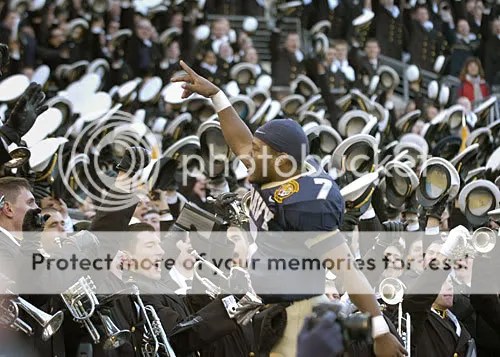
PR/KR Reggie Campbell

For three years, Reggie Campbell has been Navy’s big-play man. Whether it was scoring 5 touchdowns in the 2005 Poinsettia Bowl, ripping off long runs against Army or Air Force, or streaking past the UConn secondary on a long TD catch, Reggie Campbell was a one-man momentum changer for the Mids. It wasn’t just the big plays that made Reggie special, either. Walk past football practice on any given afternoon and you’d probably hear coaches saying, “Slots, watch how Reggie does this.” Reggie got playing time for four years not just because of what he did with the ball, but also for what he did without it. Reggie was an excellent blocker, and never gave up on a play. How often did we see someone else break off a long run with a Reggie Campbell escort down the field? Number 7 did everything on offense.

Things were a little different this year, though. Reggie led the team in receptions and still ran for 522 yards and 5 TDs, but he didn’t seem to have the same kind of offensive impact that he did in ’05 and ’06. That’s kind of the way things go in this offense; when people key in on one guy, it opens up the door for everyone else. Even though the ball didn’t find its way to Reggie as often on offense this year, he still had a huge impact on the team. With the offense needing to score points in bunches, field position was crucial. That’s where Reggie made his greatest contribution this season. He averaged 27.45 yards per kickoff return, good enough to rank in the top 20 nationally. Before this season, Navy hadn’t returned a kickoff for a touchdown since 1996; in 2007, Reggie had two. And they came at very opportune moments. His first TD return sealed the victory against North Texas. His second crushed Army’s momentum after their only scoring drive of the game. That wasn’t Reggie’s only impressive return against Army; his sideline balancing act on a punt return at the end of the first half set up a Joey Bullen field goal that might have been the knockout punch in the game. Reggie was so effective that he gave Navy good field position even when he didn’t return the ball. Attempts to kick away from Reggie led to several kickoffs going out of bounds. For the first time in years, Navy had a return man that opposing coaches feared.

Reggie Campbell leaves Navy second on the school’s career all-purpose yardage list, behind only Napoleon McCallum. Considering that McCallum was the NCAA leader in career all-purpose yards by the time he graduated, that’s a pretty incredible accomplishment.

Most Improved Player

DE Michael Walsh

The ideal 3-4 defensive lineman is big. Really big. The main idea behind a 3-4 defense is for your linemen to absorb blocks so that linebackers are free to make plays. Bigger players tend to be better block sponges. In fact, many NFL 3-4 defensive ends, such as the Chargers’ Luis Castillo, played defensive tackle in a 4-3 alignment in college. So when Michael Walsh tips the scales at 6-2, 239, it’s safe to say that he isn’t exactly the prototypical 3-4 defensive end.

Even though he’s the size of the average I-A linebacker, Michael Walsh has become Navy’s best defensive lineman. He got better as the season progressed, and played his best in Navy’s biggest games. It started with a 10-tackle performance against Air Force, including three for a loss. He had a tackle for a loss against Pitt. He had two sacks against Notre Dame, including a forced fumble that was returned for a touchdown by Chris Kuhar-Pitters. He had 9 tackles and a sack against Northern Illinois, and 8 tackles against Army. In the end, Michael led Navy’s defensive line with 57 tackles and led the team in tackles for loss (10.5) and sacks (tied Matt Wimsatt with 3). Walsh’s performance was reminiscent of another undersized lineman at Navy, Jeff Vanak. Walsh is only a junior, so the improvement he showed over the course of this season is very encouraging for 2008.

Rookie of the Year

DB Wyatt Middleton

Wyatt sort of wins this award by default. Honestly, he had as many bad games as good games. But in a year where the defensive lineup was different every week, Wyatt Middleton was a constant. He registered 88 tackles, good for 2nd on the team. No freshman contributed as much as Wyatt this year.

The Jason Van Matre Award 

QB Troy Goss

Troy Goss was a star quarterback in high school. As a junior, he threw for 2,405 yards and 27 touchdowns. In his senior year, he exploded. Troy led Burns High school to a 12-2 record with 2,326 yards passing and 28 TDs while throwing only four interceptions. On the ground, he averaged more than 9 yards per carry, running for 1,668 yards and 25 more touchdowns. He was unstoppable, or as one writer put it, “the best quarterback in North Carolina not named Chris Leak.” The North Carolina High School Athletic Association agreed, naming Troy their 3-A Mr. Football award winner (Leak won 4-A that year). So it was with high hopes that he came to the Naval Academy.

Things didn’t really work out as planned, though. Following Troy through Gate 1 was another Mr. Football, Jarod Bryant, and Kaipo, whose ascension to the starting quarterback role almost seemed to be the product of destiny. With those two ahead of him, Troy remained buried on the depth chart.

Every once in a while, you’ll find a player that is determined to contribute. A guy who doesn’t care what he does as long as it helps the team. Troy became that guy. Last year, when it became apparent that he wasn’t going to factor into the quarterback depth chart, Troy switched to wide receiver. After Brian Hampton was lost for the season, he switched back to quarterback to be #3 behind Kaipo and Jarod. He did so well that when 2007 came around, Coach Johnson decided to keep him at QB rather than switch him back to receiver. But Troy was still intent on finding a way to get on the field. He found his niche on special teams. Troy was on the punt team, recorded a tackle, and even ran a fake. He was also Joey Bullen’s holder on extra points & field goals– and with the skin-of-our-teeth kind of games that Navy was involved in this year, that was a very important job. The icing on the cake was the final posession of the Army game, when Troy led the offense on a nice drive that ran out the clock.

It was a fitting way for a player like Troy Goss to go out. Troy Goss is the personification of turning lemons into lemonade. His devotion to the team is exactly what the Navy football brotherhood is all about.

(Jason Van Matre, for those who might be new to Navy football, was one of the players I grew up idolizing. An option quarterback under recruited by Elliot Uzelac, he didn’t really fit in George Chaump’s pass-oriented offense. He changed positions and became a pretty good tailback. This award is about swallowing your pride and putting the team first.)

Play of the Year

Like there’s any doubt:

There were actually a lot of huge plays this year if you think about it. Hell, there were a lot of huge plays in the Notre Dame game alone. But there’s one play that Navy fans will still be talking about 30 years from now. I suppose an argument could be made for the 2-point conversion stop, but the sheer badassness of Ram’s leap wins out. Here’s what I said about it at the time:

The way the Naval Academy motivates you to train is through fear. That sounds bad, but it isn’t. The very first thing that you’re taught as you walk through the gates on I-Day is that you, as an individual, no longer matter. You are simply a part of a team, and your own successes and failures are irrelevant next to those of the team. Ship, shipmate, self, as the saying goes. You train not to better yourself, but to better the team. And that’s where the fear comes in; you train because you are scared to death of letting down your teammates.

Enter Ram Vela. The Navy defense, leading Notre Dame 28-21 late in the 4th quarter, had forced the Irish to a 4th & 14 on their own 32 yard line. Ram came in untouched on a blitz. Just when it looked like he was going to get a sack that would have probably sealed a Navy victory, quarterback Evan Sharpley sidestepped the rush and delivered the ball to tight end John Carlson for a 1st down. Ram missed the tackle, and it gave Notre Dame new life. It could have been a catastrophic mistake. But on yet another 4th down play, Ram Vela was sent in on a blitz once again. This time, Vela had a blocker in his path. As the tailback went to block low, Vela would not be denied. The result was the above play, which will live forever as part of Navy football legend. Vela would not let down his teammates. He would not be stopped by any blocker. He would not be stopped by gravity. He would do his job. In the end, it was actually Chris Kuhar-Pitters who would get credit for the sack, which was a tremendous play of his own. But Vela taking flight will be the lasting image of the “not this time” attitude that defined the Navy team in this game.

This play is a symbol of the attitude of the Navy team, and is the easy choice for play of the year.

Game of the Year

9/22– Navy 46, Duke 43

I know, I know… How is this not Notre Dame? Especially since I just talked about Ram Vela’s play as the one that Navy fans will be talking about for years to come. Obviously, the same can be said about the Notre Dame game as a whole. Yet I chose the Duke game because, in my opinion, there might not have been a win over Notre Dame if Navy didn’t pull this one out. There might not have been another Commander-In-Chief’s Trophy or a trip to San Diego, either. Let’s set the stage.

Navy had lost two in a row coming into the Duke game. The second of those two losses was at home to Ball State, a game that Navy should have won in regulation but fumbled away in overtime. Again, what I said at the time:

The importance of this game can’t be overstated. The confidence gained or lost from winning or losing will have a huge impact in the first leg of the Commander-in-Chief’s Trophy battle next week. Win, and Navy is back on track. Lose, and you’re 1-3 with doubt creeping in and a likely 3-1 Air Force team coming to town. We hear Paul Johnson say all the time that the most important game of the season is the next one. This week, that couldn’t be more true.

(I apologize for recycling so much of my old stuff… I look at this postseason awards thing as sort of like a flashback episode on a sitcom. I’m definitely mailing it in on this one.)

How different would the season have been if Navy started 1-3 with losses to Ball State and Duke at home? Maybe you believe in momentum, maybe you don’t. But I think that a big reason why we didn’t see any offense vs. defense divisiveness in the locker room was because the team was winning. Winning keeps everyone in a good mood. Or, to paraphase something that Paul Johnson said, it’s easier to fix problems when you win. Not only that, but it was one hell of a game! Kaipo was slinging the ball all over the place. Unfortunately, so was his Duke counterpart, as Thaddeus Lewis threw for a career-high 428 yards and 4 touchdowns. Navy was down 11 in the 4th quarter, but a Ketric Buffin interception gave the Mids the opportunity they needed to get back on the pace.

If things had turned out differently against Notre Dame, then there were plays in this game that could easily have been called “play of the year.” Kaipo to OJ for 44 yards and Navy’s first touchdown. Bobby Doyle’s pass back to Jarod Bryant for a touchdown that tied the game after a 2-point conversion. Bryant’s incredible, winding QB draw after Ketric’s interception that went for 35 yards and set up Joey Bullen’s game-winning field goal. And then there was the field goal itself.

It was a huge game defined by huge plays and a spirited comeback that set the tone for the rest of the year. It didn’t end a multi-decade streak, but the Duke game gets my nod for Game of the Year.

OK, so that’s everything. Feel free to name your own, as well as give me some more categories for next year. I feel like I should be giving the offensive line an award because they were un-friggin-believable this year, but I don’t know how to categorize it. Suggestions for how I can remedy this oversight are more than welcome.

Pylon-gate

Just in case you wanted to relive the pain.

It’s funny to lurk on Utah message boards and read some the comments about the play.  “The pylon was in the wrong place! It was placed out of bounds!” Some real football experts there. Oh well.

Wrapping Up the Poinsettia Bowl

It was a great night for football in Southern California; overcast with an occasional drizzle, and tempreatures in the 50s. There was definitely a big-game feel in the parking lots around Qualcomm Stadium as nearly 40,000 fans, including over 1,000 mids, tailgated before the game. The outcome wasn’t what we’d hoped it would be, but it was still a ton of fun.

Continue reading “Wrapping Up the Poinsettia Bowl”

Killin’ Time

I’m sitting at the airport right now. My flight is delayed, so I have some time to kill. I’m at gate 40; at gate 39 is the Delta flight to Salt Lake City, so I’m surrounded by Utah fans. It doesn’t bother me, though. Right now I don’t know if I could be more proud to be a Navy fan.

I was joking around with some friends this week about Zerbin Singleton’s story. His mother was shot by a bounty hunter, he was shipped across the continent to live with relatives, was hit by a drunk driver, and his father committed suicide. We asked ourselves, “At what point would you have given up?” Fortunately, Zerb never did. How appropriate was it, then, to see Zerbin Singleton cutting across the field to catch a pass, then beat a Utah defender in a race down the sideline to put Navy within a field goal of tying the game in the last minute? I had given up, but the Navy team never did. I should have known better. This team came back from an 11-point deficit in the 4th quarter against Duke, fought through multiple overtimes against Pittsburgh and Notre Dame, and rallied to beat North Texas despite trailing by 18 on 3 separate occasions. This is a team whose defense saved its best plays for the end of games, and who didn’t miss a beat when its starting quarterback missed a game. How foolish was I, then, to have abandoned all hope after Darrell Mack found the end zone with 1:27 left to play?

That will be the story of this 2007 Navy football team. The never-say-die attitude of Zerbin Singleton was carried on by his teammates until the last series of the last game. There were several points during the season where everyone might have understood if Navy just ran out of steam. They could have given up, and nobody would have thought any worse of them. But that wouldn’t have been acceptable to themselves, and that’s the attitude the Mids played with.

Hopefully my DVD recorder picked up the game, although my wife says that she isn’t optimistic. I have some thoughts on the game but I want to see it again to validate them. I also have some more pictures to upload, but my camera is in my checked bag. So for now, I just wanted to pass along how proud I am of these players. I wouldn’t trade these guys for anything. Beat Towson.

The Birddog Poinsettia Bowl Trip, Part 3


Sorry it took so long for me to get around to part three here. I have been extremely busy, and it has been extremely fun.

By the way, I’m staying with my friend Tom. Tom says he wants all the single ladies out there to know how good of a host he is and how cool his place is. Anyway, on to the pictures.

Continue reading “The Birddog Poinsettia Bowl Trip, Part 3”