
Learn the name, people. You’re going to be talking about him for a long time to come.
The first overtime game in the 80-year history of Navy-Notre Dame became the first Navy win in the series since 1963, a 46-44 3OT thriller. There will be no more talking about the price of gas back then, no more talking about what the #1 song was, and no more talking about John F. Kennedy. And while I enjoy listening to anything Roger Staubach has to say, he never again will give another interview about being the quarterback of the last Navy team to beat Notre Dame. Because now, he isn’t. That title belongs to Kaipo-Noa Kaheaku-Enhada.
Kaipo was not intimidated by the big-game atmosphere. He thrived on it. When the Notre Dame Stadium crowd got loud, Kaipo would wave his arms to tell them to get louder. When the cameras were on him, Kaipo always had a smile on his face. He had boundless energy. He knew.
And knowing is what you’re taught at the Naval Academy. Paul Johnson talked to the players before and during the game, asking them, “Do you believe you can win?” With all due respect to PJ– and he’s due a whole hell of a lot of it– it isn’t about believing. It’s about knowing. It’s the difference between faith and confidence. You see, believing that you can do anything, while the theme for many a wonderful movie on the Disney Channel, is a bad thing in the military. Having faith in your own abilities means that eventually, you’ll bite off more than you can chew. When you do that, you endanger your own life as well as the lives of those around you. That isn’t what they teach at USNA. Instead, they teach training. Train yourself until you can’t get it wrong. Then, you don’t need faith; you have the confidence of experience. You know what you can do because you’ve done it before. And Kaipo knew. That’s the difference between this Navy team and the 43 that went before it. They all believed they could win. But this team knew. And when you know, all the crowd noise in the world won’t make a bit of difference, except to make the memory that much sweeter.
The way the Naval Academy motivates you to train is through fear. That sounds bad, but it isn’t. The very first thing that you’re taught as you walk through the gates on I-Day is that you, as an individual, no longer matter. You are simply a part of a team, and your own successes and failures are irrelevant next to those of the team. Ship, shipmate, self, as the saying goes. You train not to better yourself, but to better the team. And that’s where the fear comes in; you train because you are scared to death of letting down your teammates.
 Enter Ram Vela. The Navy defense, leading Notre Dame 28-21 late in the 4th quarter, had forced the Irish to a 4th & 14 on their own 32 yard line. Ram came in untouched on a blitz. Just when it looked like he was going to get a sack that would have probably sealed a Navy victory, quarterback Evan Sharpley sidestepped the rush and delivered the ball to tight end John Carlson for a 1st down. Ram missed the tackle, and it gave Notre Dame new life. It could have been a catastrophic mistake. But on yet another 4th down play, Ram Vela was sent in on a blitz once again. This time, Vela had a blocker in his path. As the tailback went to block low, Vela would not be denied. The result was the above play, which will live forever as part of Navy football legend. Vela would not let down his teammates. He would not be stopped by any blocker. He would not be stopped by gravity. He would do his job. In the end, it was actually Chris Kuhar-Pitters who would get credit for the sack, which was a tremendous play of his own. But Vela taking flight will be the lasting image of the “not this time” attitude that defined the Navy team in this game.
On that note, I owe Ram and Buddy Green an apology. Last week, I wrote this:
If we’re going to send Ram Vela in on blitzes, then we might as well play defense with 10 people. He’s just too small, and he gets absorbed by the tackle every time. He’s a converted defensive back anyway. Just drop him into coverage. We’d probably be better off with him covering the TE than one of the other linebackers.
As it turns out, Buddy Green knows a little bit more about his players and the game of football than I do. Never in my life have I been so happy to be so wrong. And holy guacamole was I wrong.
Speaking of Buddy Green, he coached the game from the press box on Saturday. Chris Swezey noticed that too, and talked about it in his follow-up:
Saturday marked the first time since he came to Navy in 2002 that defensive coordinator Buddy Green spent the game in the coaches’ box rather than on the field. Johnson said the move was made to help Green see the field better, and that Green likely will be upstairs for the game against North Texas on Saturday.
I really think it made a difference. Navy still gave up a lot of yards to a bad offense, but Notre Dame ballcarriers didn’t have nearly the room to run that Navy’s previous opponents had. Players were in position to make plays, and Buddy Green put them there. Maybe that is the difference between those Navy defenses of years past and 2007. Maybe in previous years, Buddy didn’t have to sit in the booth because senior, experienced players already knew how to line up. We’ve seen the opposite before; a couple of years ago, Ken Niumatalolo was moved from the press box to the field because the offensive line was struggling at the time, and PJ thought they needed more hands-on leadership. Perhaps Buddy can better direct his young defense by seeing the bigger picture.
Team defense was improved, but Navy also put together a series of individual efforts that surpassed anything we’ve seen this year. With 4 sacks in the game, Navy nearly doubled its season total. Those sacks were set up in part by excellent coverage in the secondary. Seven different mids registered a tackle for a loss. Wyatt Middleton had 14 tackles. Freshman Kevin Edwards had 6 tackles and played tremendously in his first start. Nate Frazier played the way Navy fans knew he could, wrapping up 8 tackles and making the most underrated play of the game– in the second overtime, it was Nate who hit Evan Sharpley on 3rd down, causing a bad throw and holding Notre Dame to a field goal. And of course, the defense bailed out the offense twice; holding the Irish scoreless after a Shun White fumble in Navy territory, and scoring a touchdown of its own to give Navy its first lead of the game in the 4th quarter. This truly was a team victory.
Offensively, I wrote last week about the importance of manageable 3rd downs, and that we’d probably “play in a phone booth” as a result. For the most part, that’s what happened. Notre Dame focused on stopping the fullback. The spread formation is designed to open up running lanes by stretching the defense from sideline to sideline, but the Irish didn’t bother. They kept their linebackers between the tackles the entire game. To counter this, Paul Johnson brought his wide receivers in closer to the formation, and stayed that way for almost the entire game. This opened up outside runs by allowing wide receivers to make crackback blocks on linebackers attempting inside-out pursuit. When Notre Dame was forced to adjust, that’s when the fullback started to gain some yardage.
It wasn’t the most mind-blowing game on the stat sheet, with Navy totaling only 338 yards of offense. The statistics don’t tell the story of how well the offense played, though. They executed the gameplan with very few mistakes. Navy only averaged 3.9 yards per rush, but that was by design. The goal was to set up 3rd & short. Coach Johnson was asked about the importance of manageable 3rd downs in his postgame press conference:
It’s real important, and that’s why I call plays the way I do. There was probably some things that we could’ve had in the passing game. But there’s no use in taking a chance when you know you’re going to get four downs. I’m not real smart in math, but 3 a pop will get you 10 in four tries. That’s kind of the way we play, and the way we have to play where we are.
The most impressive performance of the whole afternoon might be that of the offensive line. This is the first Navy-Notre Dame game I can remember where the Navy o-line wasn’t just effective; they were dominant.
Does it matter that this Notre Dame team is no good compared to the last couple of years? No. Navy had lost to bad Notre Dame teams as well as good ones over the last 44 years. And nobody seems to remember that the team that Navy beat in 1963 only won two games. Does it matter that Charlie Weis made some questionable coaching decisions? No. That’s part of the game sometimes. As time goes on, all people remember is the final score. That, and superhuman sacks.
Extra Point: Charlie Weis and Notre Dame deserve a lot of credit for the grace with which they handled the loss. I was never as caught up in the Weis love-fest as most people when he led the Irish over to join Navy in singing Blue and Gold in 2005. I thought he did it because the cameras were on. It’s easy to be gracious after a win. But Weis showed that he was just as gracious in defeat. Not only did he lead his team to the Navy fans to sing Blue and Gold, but he also went out of his way to shake the hands of several Navy players. Some Irish fans have been blasting Weis for the comments he made to a sideline reporter after the game, but I heard nothing to be offended about as a Navy fan. Weis’ playcalling might be subject to criticism, but the graciousness with which he conducted himself afterwards should not.
Seeing Notre Dame fans line the tunnel to the locker room after the game, giving Navy players high-fives, was pretty cool too. I saw more of a connection between these two schools than I ever saw out of Air Force, a school that Navy is “supposed” to regard as a sibling.

 Delaware will still try to nickel and dime their way down the field, but this year’s squad has a whole new element: Omar Cuff. Cuff played in that 2004 game as a freshman, but had only 5 carries. It was his second game as a running back. He began 2004 as a defensive back, but was switched to RB halfway through the season. That move paid some large dividends for the Blue Hens, as he had 4 100- yard games over the second half of the season including a 170-yard performance in the playoffs against William and Mary. Cuff showed that his performance was no fluke, following up that freshman campaign by being named a third-team All-American his sophomore year. After missing four games last year due to an ankle sprain, Cuff has regained his All-American form, having already rushed for 863 yards and 20(!) touchdowns through seven games. He had 200 yards in the Blue Hens’ last game vs. Northeastern, and was the talk of the college football world in Week 1 following a 244-yard, 6 TD performance at William and Mary.
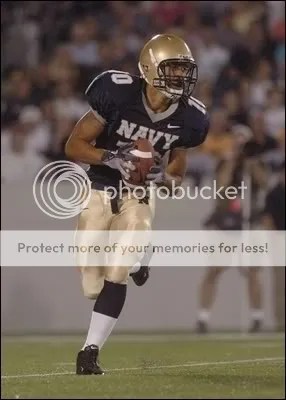 Things look a little better for Navy on the other side of the ball. Kaipo was able to shake off his neck injury and has been practicing all week, so the offense should be healthy. Having Kaipo back is good news for a team that’s about to face I-AA’s 8th-ranked run defense. But what’s the story behind that lofty ranking? We’ve said it before; statistics are as much a factor of who you’ve played as they are of how you’ve played. I’m not referring to Delaware’s strength of schedule, either. Teams that play Navy tend to see their pass defense ranking vault up the charts. That isn’t because our opponents play good pass defense; it’s because Navy doesn’t pass. The same can be said of Delaware’s opponents so far this season. The highest ranked rushing offense that Delaware has faced is Rhode Island’s, which is ranked #12 in that category and racks up 242 yards per game. While Delaware did hold the Rams to 187 yards on the ground, that isn’t necessarily a big accomplishment. Rhode Island isn’t very good. For an apples to apples comparison, let’s look at Rhody’s game vs. Army. The Woops have the 88th-ranked run defense in I-A, and they held Rhode Island even fewer rushing yards than Delaware– 158. Outside of Rhode Island, the Blue Hens have faced rushing offenses ranked only 59, 72, 78, 89, and 108 in I-AA. Even West Chester, Delaware’s annual Division II opponent, is only ranked 61st in D-II rushing offense. Delaware’s rushing defense looks more impressive than it really is because they play teams that don’t run.
 The way Navy’s defense has played this year, one mistake by the offense has been enough to put a game out of reach. Three mistakes, and it’s sure to result in a blowout. After Navy’s offense gave up three turnovers on Saturday afternoon, that’s exactly what happened. A homecoming crowd of nearly 37,000 saw Kenny Moore catch 15 passes for 181 yards as Wake Forest thumped Navy, 44-24. The loss, which brought Navy’s record down to 4-3, was the result of poor play in all three phases of the game for the Mids. We’ll start with the offense.
 The Birddog