
 OK, this is getting a bit ridiculous.
Yes, Navy finally beat Notre Dame. But holy cow, you’d think that World War II just ended. Classes cancelled? The Governor declares November “Navy Football Month?” Come on now. I agree that it’s hard to overstate the significance of this win, but the season isn’t over yet. Yes, as fans we can revel in the victory as long as we want, but the team really doesn’t need any more distractions than they are already getting from the media and their fellow mids. I can’t even imagine how hard it is to remain focused after such a landmark victory. It might be hard, but Paul Johnson is doing his part to keep his team facing forward. On Monday he made it known that he wouldn’t be talking about Notre Dame anymore. “Today is the last day we will talk about Notre Dame,” he said at his daily practice press briefing. “This is it. Starting tomorrow we are only talking about North Texas.”
Distraction is the theme of the week as the Mids hit the road once again, this time to Denton, Texas, and the University of North Texas. While the Mids are fighting off the dreaded “letdown” game, UNT is facing some issues of its own. Three Mean Green players have filed a complaint with the NAACP, claiming racial bias from the team’s coaching staff. I have absolutely no insight into the validity of these claims and don’t really want to get into the specifics very much. Regardless of the veracity of the allegations, this has to be driving a wedge into the UNT football team.
For the most part, I think that off-field distractions are overrated. When a player is having legal problems, he’s usually as focused as ever on the field. After worrying about his problems all day, getting into the game is probably the guy’s only way to escape them, if only for a while. This is different, though. UNT’s problems aren’t off the field. Instead, they are at the very core of what makes up a team: trusting your coaches and trusting your teammates. It would be impossible for this not to disrupt practice. But for North Texas, it’s really just one more problem to add to the list.
Once upon a time, North Texas was the Sun Belt Conference. From 2001-2004, Darrell Dickey’s team went 24-1 in conference play, with four Sun Belt titles and the New Orleans Bowl berths that went with them (including a win over Cincinnati in the 2002 game). Dickey’s power running offense made Division I-A rushing leaders out of Patrick Cobbs in 2003 and Jamario Thomas (as a freshman) in 2004. But the wheels fell off the wagon in 2005, and after consecutive 9-loss seasons, Dickey was fired the following year. UNT didn’t have to go very far to find Dickey’s replacement. About 30 minutes south of campus is Southlake, Texas, home of Carroll High school and its coach, Todd Dodge. Dodge was named head coach of North Texas on December 12th.
Hiring a high school coach seems like a risky move, but it isn’t without precedent. It isn’t even the first time that North Texas has done it; in 1991, they hired Dennis Parker from Marshall High School. Notre Dame’s hire of Gerry Faust in 1981 is the most famous example, but it is the success of Art Briles at Houston that really paved the way for North Texas to hire Dodge. Briles came to Houston after a 3-year stint as Texas Tech’s running backs coach. What interested Houston, though, was the 12 years Briles spent prior to that as the head coach of Stephenville High School. Stephenville won 4 state championships under Briles. Over one 6-year stretch, Briles and the high-octane offense he developed posted a 91-11-1 record. He brought that offense with him to Houston, where he has led the Cougars to 3 bowl games in 4 years and the 2006 Conference USA title.
Dodge can boast similar success during his time at Southlake Carroll. Recognized as one of the top high school programs in the country each year by several publications, Carroll won four 5A state titles with Dodge at the helm. Since taking over the team in 2000, Dodge compiled a 98-11 record and ended his stint as the Dragons’ head coach on a 48-game winning streak. Dodge had his own high-flying offense that set the Texas 5A record for most points in a season, scoring 764 in 2005.
(A tangential story– I had a layover in Dallas when I was flying home from the 2004 Emerald Bowl. While my plane was on final approach to DFW, I looked out the window and saw a very nice football field/stadium with “Dragons” written in the end zones. I kept thinking to myself, “what I-AA team with the nickname ‘Dragons’ is near Dallas?” Then it hit me; that wasn’t a college stadium. It was Carroll High School. I think one of the Under Armour commercials was filmed there. They sure take their football seriously in Texas, not that you didn’t already know.)

Todd Dodge has a similar backgroud to Briles, but his results at the college level haven’t kept the pace. North Texas is 1-7 this year, including a 1-4 mark within the Sun Belt Conference. It isn’t all too surprising, considering that he’s attempting to install a wide-open passing game on a team full of players recruited for Dickey’s running game. At least, that’s what you’d think. A closer look reveals that their offense has been able to move the ball. North Texas is ranked 12th in Division I-A in passing offense, averaging close to 300 yards per game. This, despite playing a schedule that includes Oklahoma and Arkansas. In fact, in 4 of the Mean Green’s 7 losses this year, they’ve outgained their opponent. They had 527 yards of offense against Louisiana-Lafayette and a whopping 613 yards against SMU. Wide reciever Casey Fitzgerald had 18 catches for 327 yards in that game. Navy will be challenged to limit the big play this week. Through 8 games, North Texas has 7 more plays of 20 yards or more (41) than they did in all 12 games last year. With an offense this explosive, what could possibly be the problem?
For starters, the Mean Green offense implodes just as often as it explodes. Freshman quarterback Giovanni Vizza assumed the starter’s role in the 5th game. He plays behind a line that starts two freshmen, two sophomores, and only one returning starter from 2006. That combination of a freshman quarterback and young linemen means sacks and turnovers. Whether it’s Vizza or junior Daniel Meager, North Texas quarterbacks have found themselves running for their lives. The North Texas line has given up 31 sacks this year through 8 games. With that much pressure being applied to a freshman quarterback, it’s no surprise that Vizza has thrown 9 INTs in 4 games as a starter. So while North Texas has some pretty impressive numbers in total passing yards, their passing efficiency is ranked 98th in the country. Navy had a season-high 4 sacks against Notre Dame. If that was a sign of progress instead of just a flash in the pan, then the Mids have a good chance of adding to their meager total of 9 takeaways on the year.
As hot & cold as the offense has been, those problems pale in comparison to the struggles that the Mean Green defense has faced this year. North Texas is ranked 116th in total defense, giving up almost 500 yards per game. Of course, playing Oklahoma and Arkansas doesn’t help the numbers. It might help to take a look at another game, though. Louisiana-Lafayette doesn’t run Paul Johnson’s offense, obviously, but it does run a different kind of spread option attack. The Ragin’ Cajuns lead the Sun Belt in rushing offense and are 8th nationally, averaging 241 yards per game. Against North Texas, they averaged 8.3 yards per carry, running the ball 36 times for 300 yards. North Texas dominated time of posession in that game, holding onto the ball for 40:36. UL-Lafayette just didn’t need that much time to score, with 116 of their 300 rushing yards coming on touchdown runs of 43 and 73 yards. Five of the Ragin’ Cajuns’ 6 scoring drives took less than two minutes.
An interesting twist to this game is that Chuck Petersen, a Fisher DeBerry assistant for 17 years, now coaches safeties at North Texas. Petersen was Air Force’s offensive coordinator for seven years. Having run an option offense himself, it will be interesting to see what kind of input he has in how to defend Navy.
Like always, this is a big game for Navy. North Texas is by no means a world-beater, but they play a style of offense that has ripped Navy’s defense to shreds this year. For the defense, it’s a chance to prove that last week’s performance was genuine improvement and not a one-hit wonder.
 Enter Ram Vela. The Navy defense, leading Notre Dame 28-21 late in the 4th quarter, had forced the Irish to a 4th & 14 on their own 32 yard line. Ram came in untouched on a blitz. Just when it looked like he was going to get a sack that would have probably sealed a Navy victory, quarterback Evan Sharpley sidestepped the rush and delivered the ball to tight end John Carlson for a 1st down. Ram missed the tackle, and it gave Notre Dame new life. It could have been a catastrophic mistake. But on yet another 4th down play, Ram Vela was sent in on a blitz once again. This time, Vela had a blocker in his path. As the tailback went to block low, Vela would not be denied. The result was the above play, which will live forever as part of Navy football legend. Vela would not let down his teammates. He would not be stopped by any blocker. He would not be stopped by gravity. He would do his job. In the end, it was actually Chris Kuhar-Pitters who would get credit for the sack, which was a tremendous play of his own. But Vela taking flight will be the lasting image of the “not this time” attitude that defined the Navy team in this game.
 Delaware will still try to nickel and dime their way down the field, but this year’s squad has a whole new element: Omar Cuff. Cuff played in that 2004 game as a freshman, but had only 5 carries. It was his second game as a running back. He began 2004 as a defensive back, but was switched to RB halfway through the season. That move paid some large dividends for the Blue Hens, as he had 4 100- yard games over the second half of the season including a 170-yard performance in the playoffs against William and Mary. Cuff showed that his performance was no fluke, following up that freshman campaign by being named a third-team All-American his sophomore year. After missing four games last year due to an ankle sprain, Cuff has regained his All-American form, having already rushed for 863 yards and 20(!) touchdowns through seven games. He had 200 yards in the Blue Hens’ last game vs. Northeastern, and was the talk of the college football world in Week 1 following a 244-yard, 6 TD performance at William and Mary.
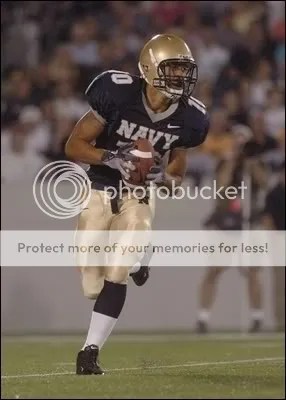 Things look a little better for Navy on the other side of the ball. Kaipo was able to shake off his neck injury and has been practicing all week, so the offense should be healthy. Having Kaipo back is good news for a team that’s about to face I-AA’s 8th-ranked run defense. But what’s the story behind that lofty ranking? We’ve said it before; statistics are as much a factor of who you’ve played as they are of how you’ve played. I’m not referring to Delaware’s strength of schedule, either. Teams that play Navy tend to see their pass defense ranking vault up the charts. That isn’t because our opponents play good pass defense; it’s because Navy doesn’t pass. The same can be said of Delaware’s opponents so far this season. The highest ranked rushing offense that Delaware has faced is Rhode Island’s, which is ranked #12 in that category and racks up 242 yards per game. While Delaware did hold the Rams to 187 yards on the ground, that isn’t necessarily a big accomplishment. Rhode Island isn’t very good. For an apples to apples comparison, let’s look at Rhody’s game vs. Army. The Woops have the 88th-ranked run defense in I-A, and they held Rhode Island even fewer rushing yards than Delaware– 158. Outside of Rhode Island, the Blue Hens have faced rushing offenses ranked only 59, 72, 78, 89, and 108 in I-AA. Even West Chester, Delaware’s annual Division II opponent, is only ranked 61st in D-II rushing offense. Delaware’s rushing defense looks more impressive than it really is because they play teams that don’t run.
 The Birddog