Before the game on Saturday, John Feinstein told listeners on the Navy radio network that Army head coach Stan Brock’s job could depend on the outcome of that afternoon’s game. But unfortunately for Brock, it was over almost before it began.
Army fans and coaches believe that the talent level at West Point is about same as at Navy. At the very least, after hanging with Navy for a quarter or so in 2005 and keeping the Mids from pulling away in 2006, many people said that Army was at least “closing the gap.” Chip Bowden said that Army plays “lots of teams better than Navy.” Army AD Kevin Anderson must think that Army is talented enough, because he said in a press conference this week that he expects his new coach to win right away. But over the last few years of Navy’s unprecedented 7-game winning streak over Army, there are some plays that stand out as symbols for just how much Navy has separated itself talent-wise (or more specifically, speed-wise) relative to its fellow service academy. In 2005, there was Reggie Campbell turning on the jets and scoring on a 54-yard option pitch at the beginning of the second quarter. On the first play of the fourth quarter, Adam Ballard– a fullback–took a handoff from Lamar Owens on a trap play and outran Army’s defensive backs for a 67-yard touchdown. Last year, Zerbin Singleton took a toss from Kaipo and ran away from the Army defense much like Campbell did in ’05. Not to be outdone, Reggie returned a kickoff for a touchdown in the second quarter. Nobody on the field could catch Reggie… Except for Singleton, who was running beside him, escorting him to the end zone.
In Saturday’s 34-0 steamrolling of the Black Knights, it was more of the same. There was Shun White leaving everyone behind on Navy’s third play from scrimmage, streaking down the sideline for a touchdown. There was Army running back Wesley McMahand taking a pitch with literally nobody in front of him, only to have the Navy defense close in on him immediately. Army’s Patrick Mealy put together a great kickoff return… until he was caught from behind by Jordan Eddington. Think about that; Army’s kick returner being run down by one of Navy’s reserve linebackers. And when linebacker Ram Vela intercepted Chip Bowden’s pass with less than a minute left in the game, he pulled away from Army’s wide receivers as he streaked down the sideline. It’s amazing how a game traditionally renowned for being so evenly matched has become so one-sided. But there’s no arguing with the evidence. We like to focus on Xs & Os around here because coaching and effort are usually how Navy wins games. The Mids can’t just roll our helmets onto the field and expect to win, as PJ used to say. Don’t get me wrong, that’s still true with the Army game. But looking up and down Army’s starting lineup, it’s hard to imagine any more than one or two players that would crack Navy’s. The story of each game is becoming less and less about coaching and individual effort and more about sheer ability.
Not that coaching isn’t a factor too. Beyond the obvious reasons, I was interested in this game to see how Buddy Green would defend against an offense that is somewhat similar to Navy’s. Unfortunately for my curiosity, that isn’t really what I got. It was pretty evident that Coach Green didn’t have much respect for Army’s passing game or outside running– two things that defensive coordinators ignore at their own risk against the Mids. We’ll start with how Navy contained Army’s top (*cough*only*cough*) threat, fullback Collin Mooney. I mean other than just through sheer physical domination up front, since Nate, Matt, and Jabaree absolutely owned the line of scrimmage. Since so much of Army’s offense revolved around Mooney, Coach Green decided to sell out a bit to stop him. That selling out came in the form of safety Wyatt Middleton. Safeties are usually the last line of defense against option pitches, but Green sent Middleton charging to the line of scrimmage on most plays to spy on Mooney. If Wyatt saw that Mooney didn’t have the ball, he changed direction and went for the quarterback.
If someone tried this against Navy, they’d be burned like the tracks of a DeLorean with a flux capacitor. But Army couldn’t take advantage. To their credit, the Black Knights ran more option plays than I expected; certainly a lot more than they ran in other games. But on those few plays where Chip Bowden did read his way outside, Army’s running backs weren’t fast enough to outrun Navy’s defense. Army only got 10-12 yards on plays that Navy could have– and did– take all the way.
One other thing that the Navy defense did well was confuse the quarterback. I wrote about Army’s use of the mesh charge in last year’s game, with defensive linemen soft-playing the fullback before taking the quarterback. Last week, the Mids turned the tables:
I once asked a coach I respect how he would defend Navy’s offense. He told me that he’d focus less on scheme and more on confusing the quarterback. Give him several different reads to make, and if you find one he struggles with, run it at him until the offense adjusts. Buddy Green did a good job of doing just that. Stan Brock attempted that fake field goal because he knew that he couldn’t move the ball on Navy’s defense. He had to take advantage of the great field position given to him on the kickoff return because he didn’t know if he’d ever get that same opportunity the rest of the game. Sure enough, he never did.
Offensively, Ivin Jasper had prepared the Mids to face the same tactics that Army used last year. You’ll recall that the Black Knights pinched Navy’s tackles to prevent them from blocking the middle linebacker. To prevent that, he had his tackles release outside the defensive end:
Not the prettiest of plays, but the tackle forced the middle linebacker to alter his path enough for Shun to run by him.
The tackle released outside on Shun’s long touchdown run, too. But Army wasn’t trying to pinch the tackle on that play. The playside linebacker tried to play the pitch, but Shun ran through the arm tackle. Instead of running to cover the quarterback, the middle linebacker played the fullback. The tackle, who would usually block the middle linebacker, was then able to move on to the backside safety. That was the block that Shun needed, and off he ran to the end zone.
With that, it was “here we go again” for the Black Knights.
There were a couple of other interesting bits about Coach Jasper’s offense. Take a look at this picture:
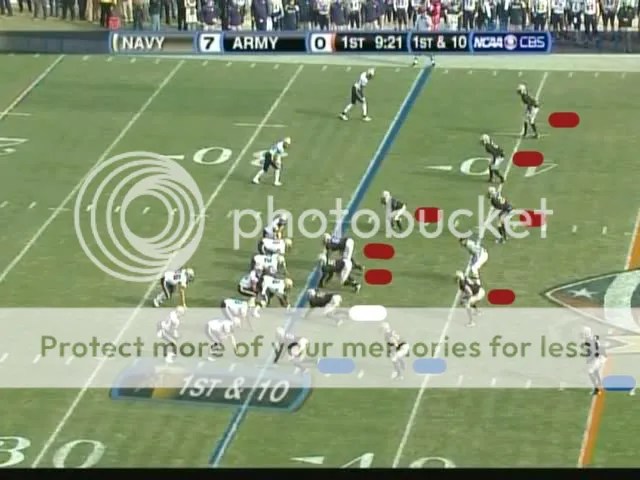
This play came early in the first quarter. A lot of times you’ll see the coaches throw in a few different formations early in the game to see how the defense will react. This is a good example of that. Coach Jasper brought twin wide receivers to one side of the formation. When he did that, Army countered by bringing seven (!) guys to that side of the field. One DT lined up over the center, leaving only three defenders to cover the other side of the formation. That’s a lot of ground for three people to cover, and Jasper took advantage of it. Later in the quarter he called a fullback option, with the backside guard pulling. The defensive end (the pulling guard’s assignment)actually takes himself out of the play by running to the middle of the field on his own. Kaipo options off of the playside linebacker, which leaves only the safety, who is blocked by the A-back. Poor Anthony Gaskins is left running around just looking for someone to block. The result is a long run by Eric Kettani down the sideline. After that, running away from the twin receivers became a theme for the offense, especially when lined up on the hash marks. It left a lot of field for Navy’s slotbacks– and not just Shun White– to outrun Army defenders to the corner and get downfield.
One curious play that caught me a little off guard was the draw play run by Shun White in the third quarter. I’ve watched a lot of this offense, from Paul Johnson’s two stints at Georgia Southern, to Hawaii, to Navy. I don’t recall ever seeing this play… That is, I’ve never seen it run by PJ. We have seen it, though. A lot.
Indeed, that draw play was a staple of Air Force’s offenses under Fisher DeBerry. I’m not sure if it’s new to the Navy playbook or if it’s always been a part of Paul Johnson’s offense, but Coach Jasper deserves credit for showing us a little something different either way. It’s plays like this that give us a glimpse at how the offense will evolve under him in Annapolis.
So there you have it: the straw that broke Stan Brock’s back. Chip Bowden might think that he plays lots of teams better than Navy, but nobody handed Army a bigger defeat this season. Army is left going back to the drawing board, while the Mids are off to yet another bowl game. The blowouts may be bad for TV ratings, but they’re good for the soul. After years of heartbreaking losses, I will never, ever take these wins for granted.

 The Birddog